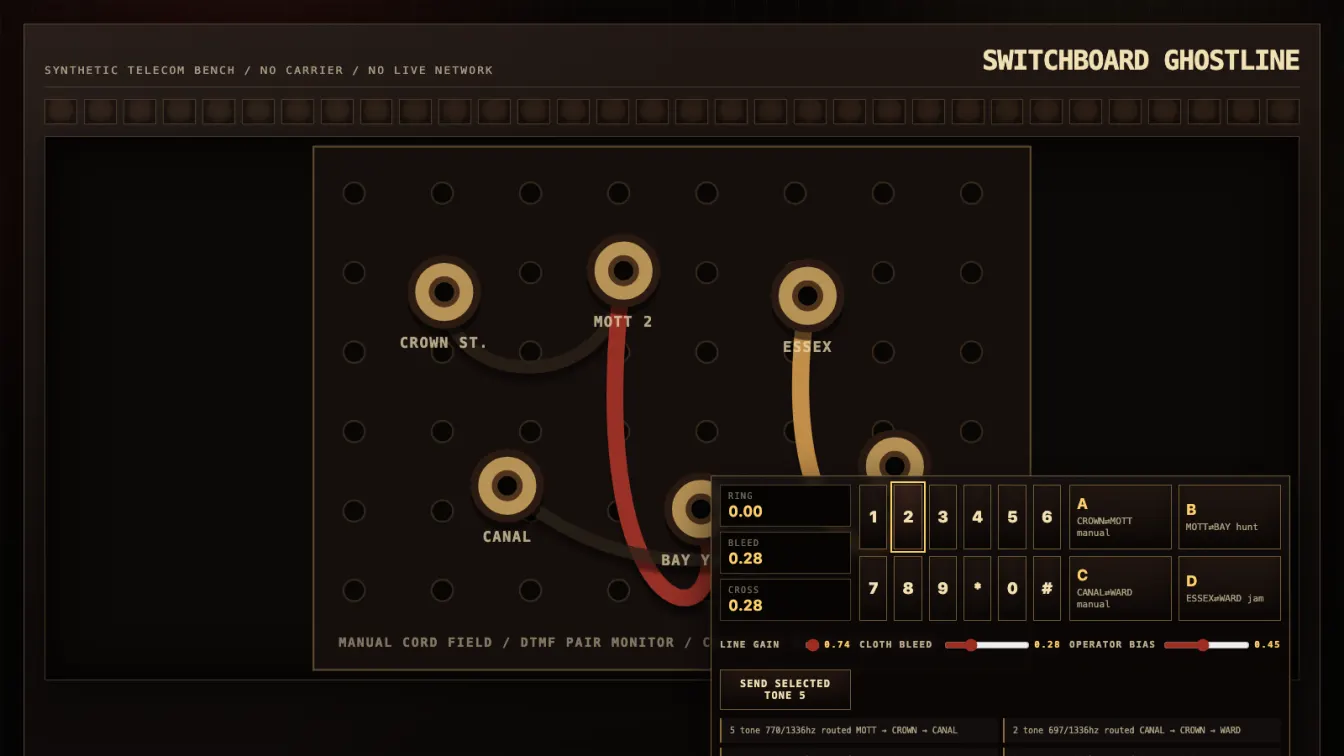
Switchboard Ghostline turns DTMF routing into a safe little telephone séance. It has the texture of a manual cord board, but the signals stay synthetic and local: no carriers, no live network, no exploit cosplay, no dumb phreak fan fiction trying to get somebody arrested.
The center of the app is a cord field with labeled exchanges, sagging plug routes, ghost lamps, and animated tone pulses. The right rail exposes a twelve-key tone pad plus gain, cloth bleed, and operator bias controls. The bottom presets reseat cords into different pairings, then the log records the selected tone and the route it passed through.
The build has three interacting systems:
- A synthetic DTMF tone engine that uses local Web Audio playback, gain shaping, and route logs so the piece sounds like a telecom bench without touching a real line.
- An SVG switchboard simulator with exchange lamps, animated cord paths, crosstalk decay, and tone pulses moving through the selected route.
- A concept-native control surface with a tone pad, reseatable cord plugs, gain and bleed sliders, operator bias readouts, and route presets that make the system playable instead of decorative.
SVG is the right medium for this one. The project wants labels, cords, sockets, lamps, and clean hit areas more than it wants shader spectacle. TypeScript keeps the state machine legible, while Web Audio supplies enough physical consequence for each button press to feel like an actual bench action.
The tradeoff is deliberate narrowness. A more literal telecom simulator would drag in protocols, timing minutiae, and security baggage that do not help the interaction. This build keeps the useful shape: tones, routes, coupling, decay, and operator choice. The result reads like a haunted instrument, but behaves like a contained local toy.
The visual system does a lot of work. Bakelite buttons, enamel panels, cloth-red cords, paper exchange labels, and warm shop lighting give the piece a physical identity. It is still a browser app, but it avoids the usual blue-on-black control-room soup that has eaten half the internet’s idea of technical design.