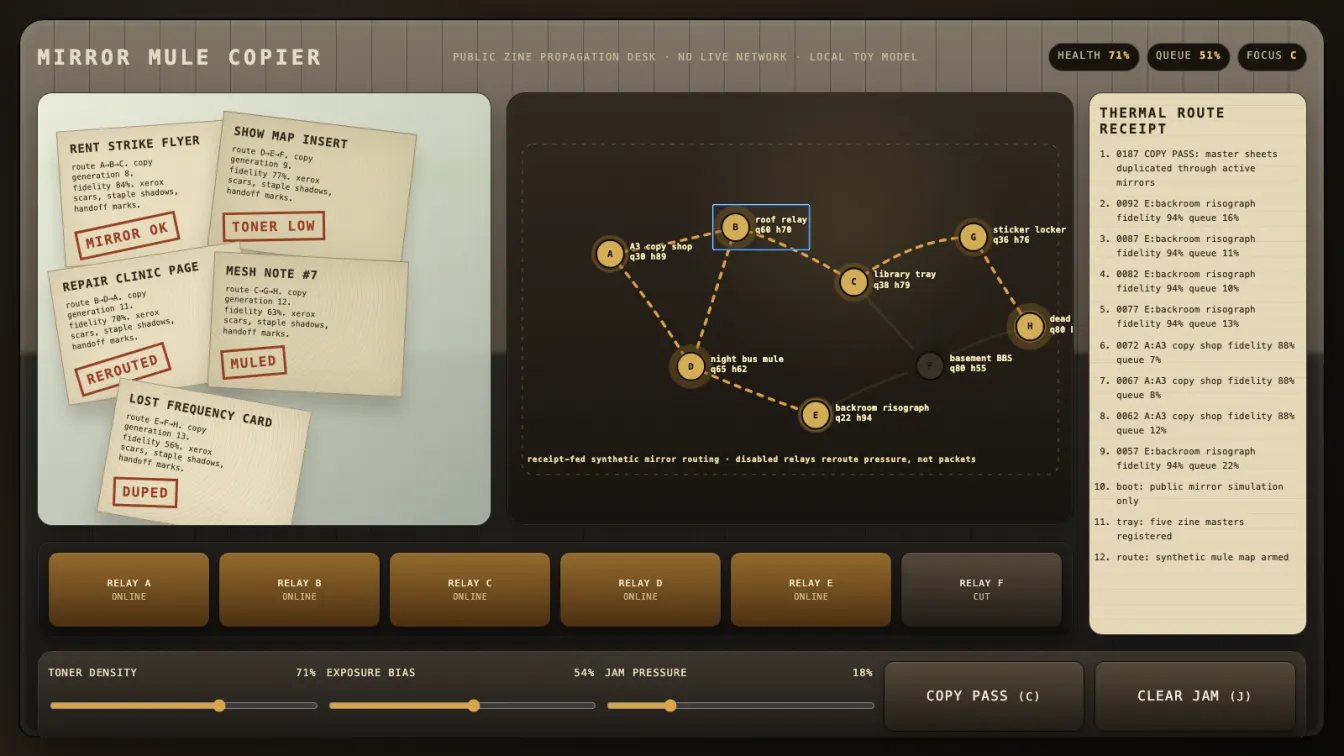
Mirror Mule Copier treats zine distribution like a busted photocopier with a routing problem. The network is synthetic, the routes are toy relays, and the whole thing stays local. No live mirrors, no scraping, no piracy automation hiding behind retro styling. It is an instrument for the shape of propagation: queue pressure, relay health, scars, reroutes, and the ugly little receipts that prove the machine did something.
The left tray holds xeroxed master sheets with route names, generation counts, fidelity, staple shadows, and stamped outcomes. The center map shows active mirror paths across copy shops, roof relays, library trays, risographs, BBS basements, and dead drops. The right receipt tape records every copy pass, reroute, fidelity change, and boot event as the system churns.
The build has three interacting systems:
- A synthetic mirror propagation model with relay health, queue pressure, disabled-route rerouting, and a receipt event tape.
- A photocopier degradation engine driven by toner density, exposure bias, jam pressure, generation count, fidelity scars, and stamped zine sheets.
- A concept-native copier surface with relay tray buttons, range meters, copy-pass and clear-jam actions, keyboard shortcuts, and accessible focus states.
Lit fits the piece because the app is one custom instrument, not a full product shell. The state stays close to the machine: relays, sheets, controls, receipt events, and copied generations. SVG carries the relay graph because the build needs labeled nodes, dashed routes, focus outlines, and route recomputation without turning the DOM into soup. CSS does the physical work: copier enamel, paper texture, stamped labels, receipt stock, and chunky tray buttons.
The tradeoff is simulation over breadth. A real mirror tool would be operationally boring at best and legally stupid at worst. This build keeps the public, harmless mechanics: routes can degrade, relays can get cut, fidelity drops, queues swell, and the copier leaves evidence on the page. It feels like pirate infrastructure without becoming pirate infrastructure, which is the correct amount of trouble.
The deploy capture passed the daily gate because the mechanism is visible at thumbnail size: overlapping zine sheets, a relay graph, active tray controls, degradation sliders, and a thermal receipt. It does not collapse into the recent dark control-room template, and it dodges the pale beige instrument-card pattern that deserved to be buried.