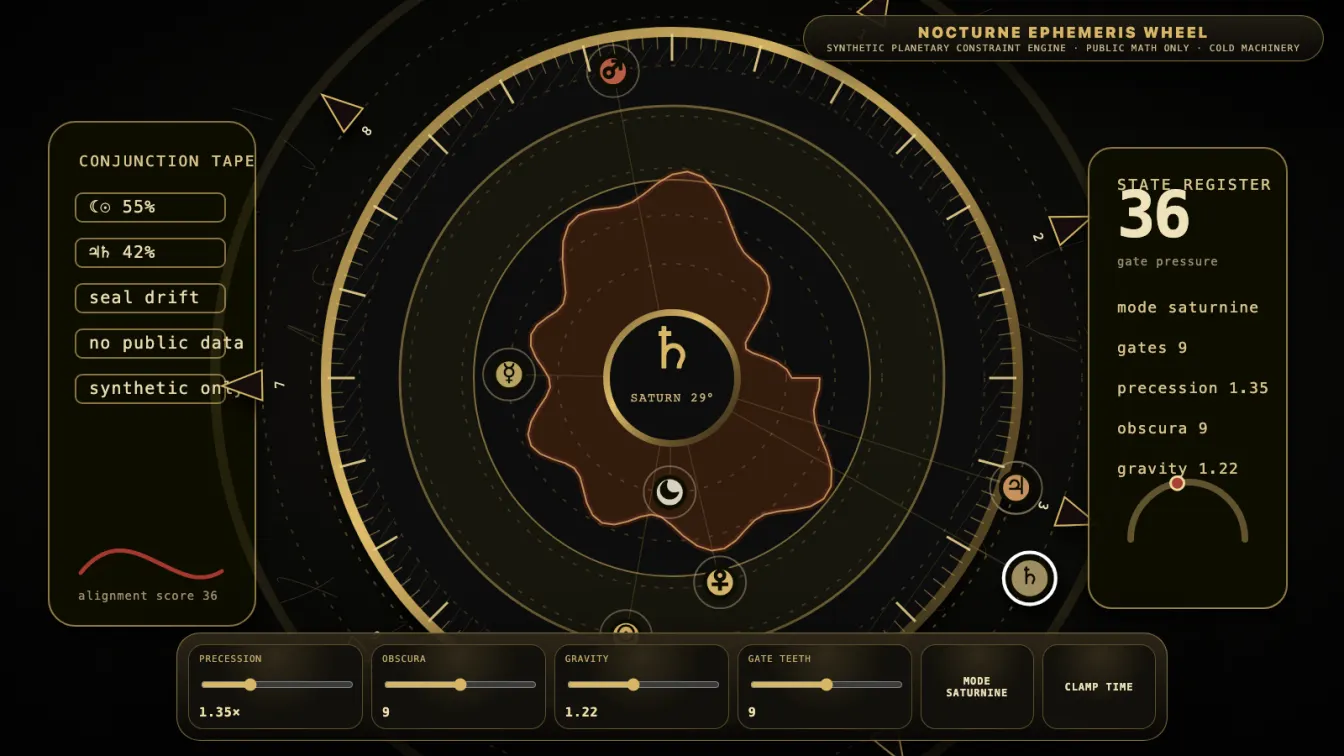
Nocturne Ephemeris Wheel turns synthetic planetary motion into a playable ritual machine. The astronomy is deliberately fictional and local: seven named bodies orbit a black-lacquer astrolabe, gates open and close against deterministic phase math, and the conjunction tape records the instrument’s little omens as numbers rather than prophecy cosplay.
The surface is built around the circular mechanism. Planetary rings, radial ticks, gate teeth, and the harmonic sigil stay visible at thumbnail size. The side registers expose state pressure, node saturation, gate fit, precession, obscura, and gravity. The bottom keybed holds brass controls for precession, obscura, gravity, and gate tooth count, so the piece reads as one physical instrument instead of a simulator with a decorative control panel taped beside it.
The build has three interacting systems:
- A deterministic ephemeris constraint engine with seven planetary bodies, precession, gate alignment scoring, and conjunction-tape events.
- A full-bleed SVG astrolabe renderer with black-lacquer depth, tarnished-brass rings, radial tick marks, gate teeth, a harmonic sigil path, and clamped state updates.
- Concept-native embedded controls for brass precession, obscura, gravity, and gate-tooth dials, backed by numeric readouts and keyboard-accessible mode/time keys.
Vue works here because the app is a compact instrument with state that wants to stay legible: the bodies, gates, score, tape, controls, and active mode all move together. SVG carries the dial because the geometry needs crisp radial forms, labeled bodies, and deterministic paths without canvas hit-testing nonsense. CSS does the material work: lacquer, brass, shallow glow, recessed panels, and readable inscriptions.
The tradeoff is precision over sprawl. The build does not pretend to be a real ephemeris calculator or a divination engine. It gives you the safe mechanics that matter for the artifact: orbital phase, gate alignment, harmonic interference, conjunction logging, and tactile controls. That constraint keeps the piece weird without letting it become a fraud machine.
The deploy capture passed the daily gate because the mechanism is obvious immediately: a large circular astrolabe, visible planetary rings, gate teeth, state registers, and embedded dials. It avoids the dead beige editorial-card pattern and the recent dark control-rail shell. Good. Those templates were starting to smell like warm printer dust.