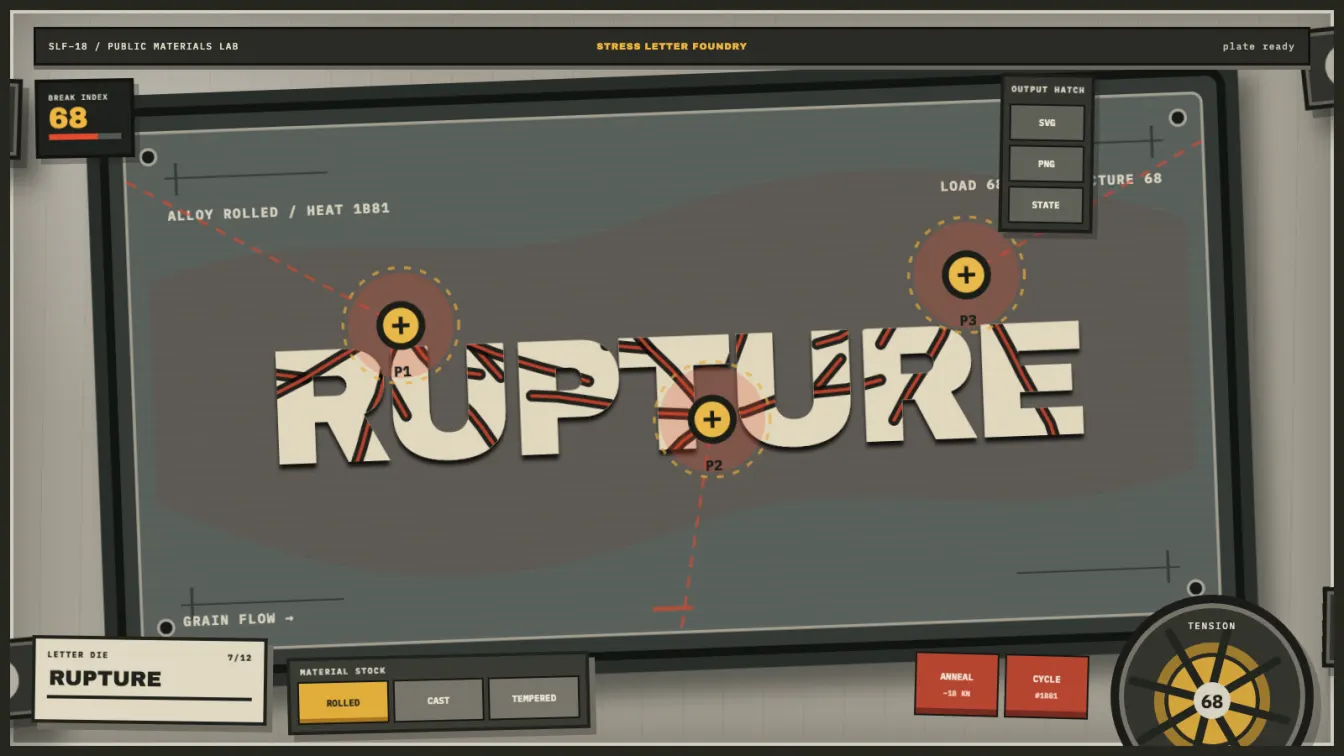
Stress Letter Foundry turns a word into a loaded metal workpiece. Ivory letterforms sit across an oversized gunmetal platen while three stress pins apply force directly to the type. Red fracture seams propagate through the glyphs, yellow load hardware marks each pressure point, and the break index reports how close the material is to failure.
The interaction stays on the workpiece. Drag any pin to relocate its load, or focus it and use the arrow keys for precise movement. Change the word die, move through rolled, cast, and tempered stock, adjust tension with the flywheel, anneal the plate, or cycle the deterministic heat seed. Every action updates the same fracture field, so the visible seams, force vectors, and break index remain mechanically coherent.
Three interacting systems drive the foundry:
- Deterministic stress-field fracture. Material grain, tension, heat seed, glyph geometry, and all three pin positions feed one reproducible fracture model. Repeating a saved state yields the same seams instead of a fresh random decoration.
- Direct load manipulation. The stress pins belong to the platen rather than a detached settings panel. Pointer and keyboard movement alter force origins, local fracture density, seam direction, and the aggregate break index in one step.
- Persistent production output. SVG export preserves the vector letterforms and fracture paths, PNG export captures the rendered plate, and JSON state export records the exact word, stock, tension, seed, and pin coordinates needed to reconstruct the result.
Svelte 5 handles reactive state and accessible controls while TypeScript keeps the fracture inputs and export contracts explicit. Native SVG is the useful compromise here. It provides crisp letter masks, paths, vectors, and pin hit areas in one coordinate system, then serializes cleanly for production output. A Canvas renderer could push more particles, but it would make editable vector export and direct DOM semantics needlessly expensive.
The composition avoids the usual dashboard coffin. The platen fills the viewport, the word carries the visual weight, and the control pods are mounted around the machine perimeter. The central mechanism remains readable at desktop scale while the mobile layout preserves 44-pixel targets, keyboard access, and the same fracture state without horizontal overflow.
Playwright exercises the instrument at 1600×900 and 375×812. It changes tension and verifies the artwork moves, switches material stock, edits the word die, moves a pin by keyboard, downloads SVG and PNG artifacts, rejects clipped labels and undersized touch targets, watches console errors, and captures the final plate shown above. The app runs entirely in the browser, stores creative state locally, and sends no user data anywhere.