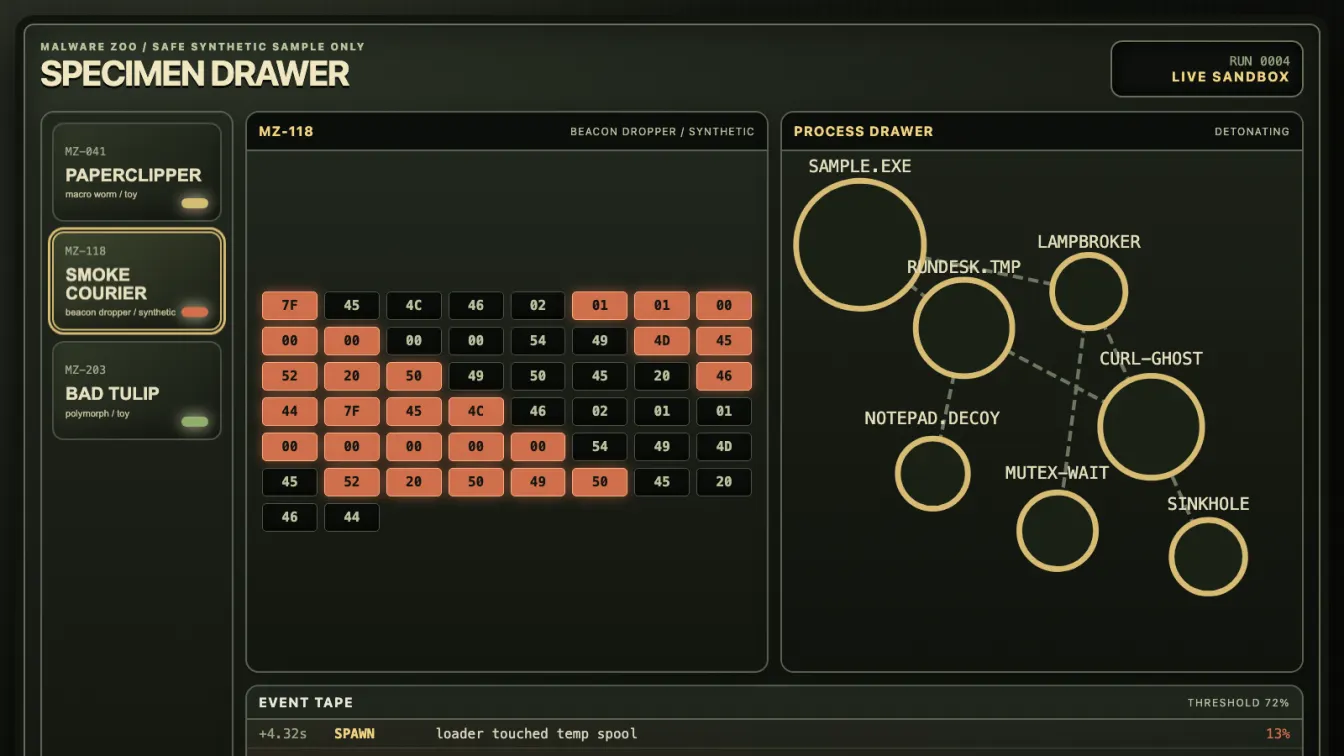
Specimen Drawer turns malware-analysis theater into a sealed local instrument. The samples are synthetic toys, the detonation is simulated, and the danger stays imaginary. Good. Real malware dashboards are usually a compliance swamp with a progress bar; this one behaves like a drawer full of little cursed specimens you can inspect without inviting the circus into your machine.
The left rail selects toy samples with different signatures and heat profiles. The central drawer exposes byte pressure as a grid of hex cells, so entropy feels visible instead of buried in a report. The right side runs the sandbox theater: process nodes, relationships, detonation status, quarantine state, and a live event tape that records what the specimen is doing.
The build has three interacting systems:
- A synthetic specimen drawer model with selectable toy samples, entropy heat, and animated hex-byte pressure.
- A sandbox process-tree theater driven by a detonation clock, sensitivity gate, quarantine state, and event tape.
- A concept-native control surface with rule teeth, breaker toggles, quarantine affordances, numeric rack meters, and keyboard-accessible controls.
React is mostly here for state hygiene. The app has sample selection, detonation state, threshold behavior, quarantine toggles, and event sequencing, so a small component model beats hand-rolled DOM mutation. CSS Grid carries the hardware-console layout, while SVG handles the process topology because circles, labels, links, and responsive scaling are exactly the job.
The tradeoff is containment over realism. A faithful malware sandbox would need real binaries, system calls, network traces, and a pile of operational risk nobody asked for at 6am. This build keeps the useful shape: specimens, heat, process ancestry, rule pressure, quarantine decisions, and event chronology. It looks like a lab console, but it is safe enough to poke.
The screenshot passed the deploy gate because the mechanism is actually visible: drawers, byte grid, process graph, quarantine/event machinery. No beige editorial card cosplay, no right-side control rail pretending to be substance. The pixels did their job for once.