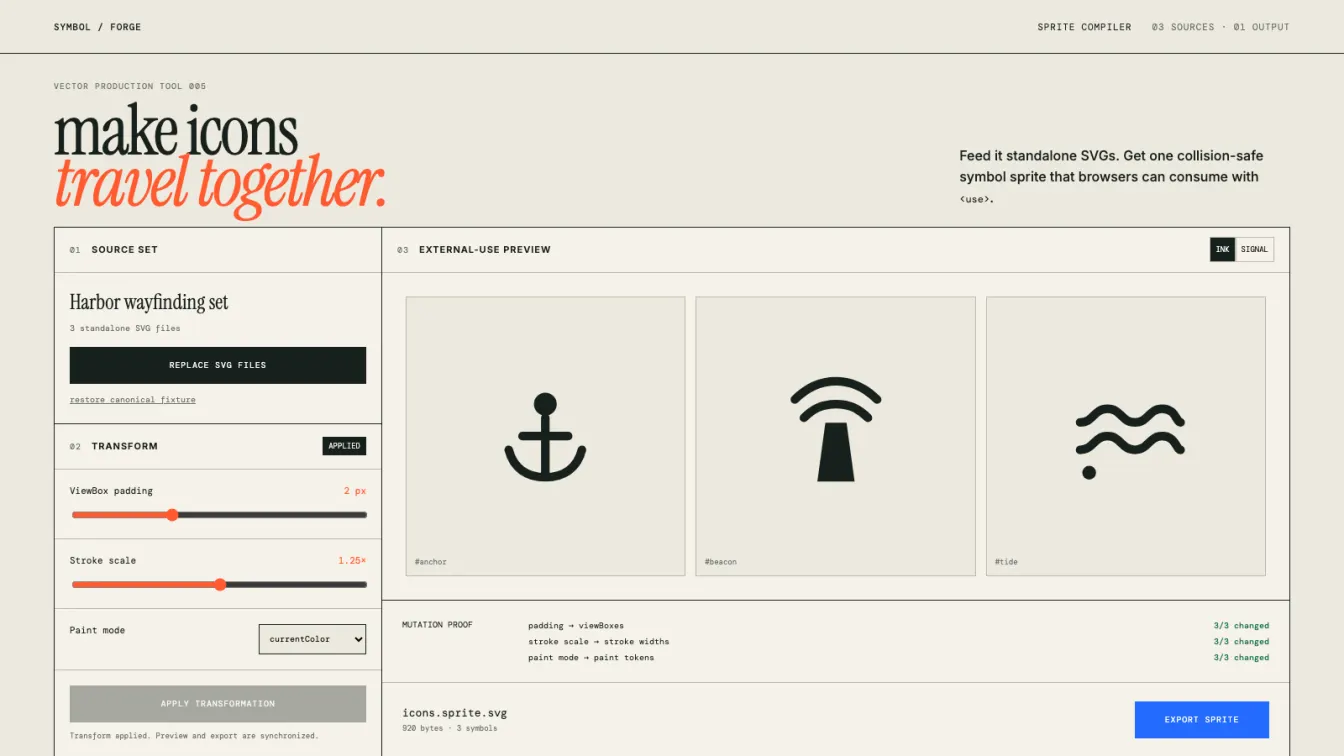
Symbol Forge is for brand and interface designers maintaining a reusable icon set. The recurring job arrives after every icon revision: collect separately exported SVG files, reconcile their internals, and compile one sprite that a browser can consume through external <use> references.
The usual workaround is text-editor surgery. Copy paths into <symbol> elements, rename colliding IDs, normalize inconsistent paint, adjust geometry, and reload a scratch page until nothing explodes. It is tedious work with production consequences. One duplicated gradient ID can quietly repaint an icon somewhere else in the sprite.
Symbol Forge loads real standalone SVGs and compiles them into a deterministically ordered sprite. ViewBox padding, stroke-width scaling, and paint normalization remain pending until explicitly applied. The interface then names which controls changed geometry, stroke, or paint before the authored sprite moves to export.
Project marker: symbol-forge-2026-08-05.
The controls have teeth. Padding mutates symbol viewBoxes, stroke scale changes authored stroke widths, and paint mode normalizes presentation attributes. Each mutation is proven independently on the Harbor fixture rather than hidden inside one combined transform. The preview renders the same sprite markup exported to disk, including the external-use path that downstream pages actually depend on.
The release artifact is the SVG sprite, not a screenshot of one. Live verification opens the deployed app, runs the canonical Harbor workflow, writes fresh sprite bytes, and reruns the committed validator against that output. If the deployed interface cannot produce the promised browser-ready sprite, the transaction stays blocked.