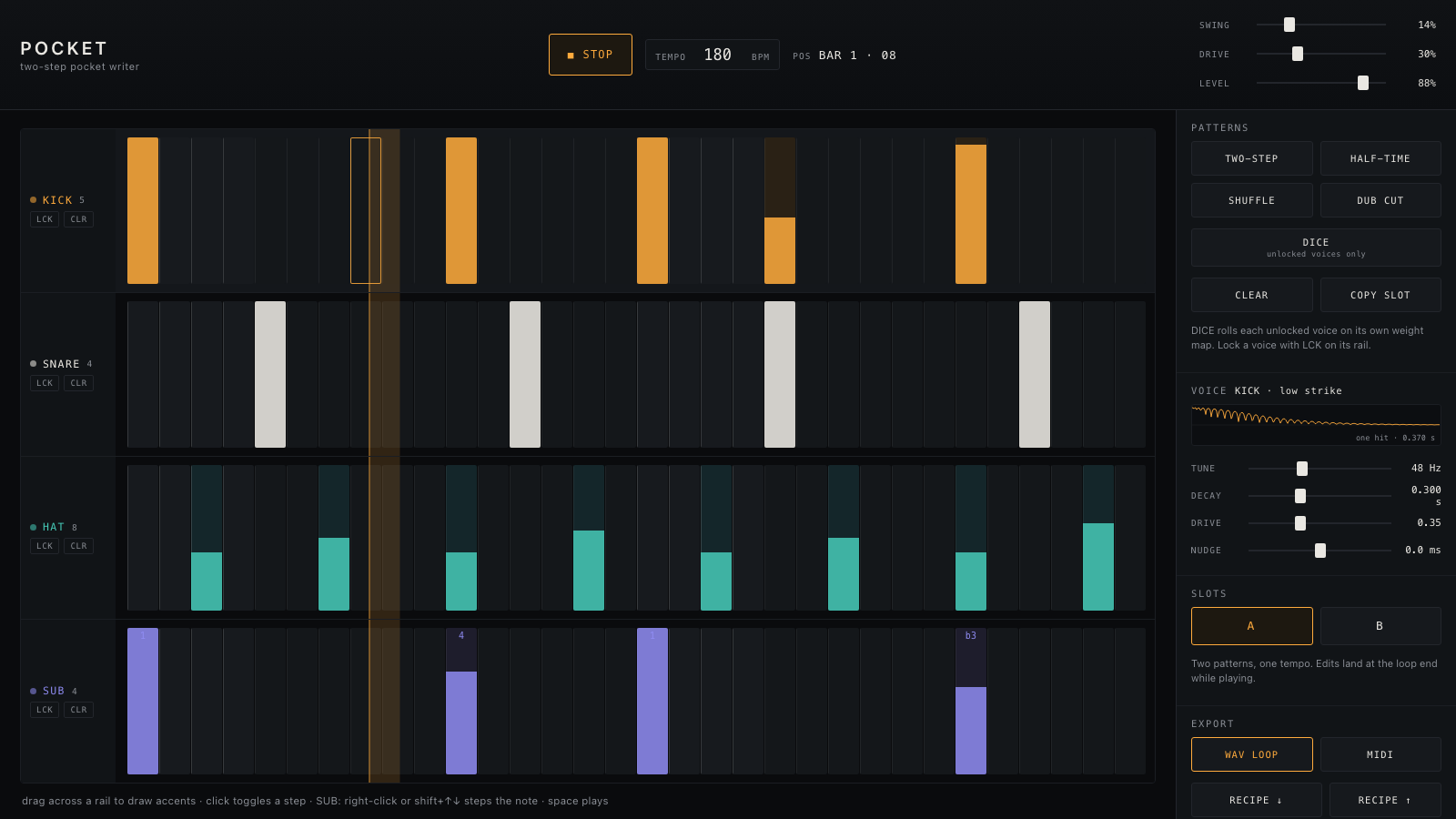
Two-step is a timing argument. The kick and the snare agree on where the bar is, and everything else is a decision about how much room the pocket leaves for a sub and a vocal. Most of that argument happens in a DAW piano roll at eleven at night, which is a slow place to have it.
POCKET is a 32-step instrument for having it quickly. Four rails: kick, snare, hat, sub. Drag across a rail and it writes hits along the stroke, with the pointer height setting velocity at every step it crosses. One gesture draws an accent contour, which is the part of a break that a drum machine usually flattens into a row of identical squares.
The voices are synthesized, not sampled. A pitch-swept kick, a body and noise snare, a filtered metallic hat, and a scale-locked sine sub. Each one exposes tune, decay, drive, and nudge, so the kick can sit four milliseconds late and the hat can sit clean on the grid. Nudge is per voice because that is how a pocket actually bends.
Nothing in the voice set will give you a roll or a ghost snare. The master is hard-clipped on the way out. The point is minimal: after the pattern is right, the only thing left to argue about upstream is sound design.
The sub rail carries note names. Right-click a sub step and it walks the scale, so the bass line is written in the same pass as the drums instead of being a second session. Root and scale are separate controls, and the note letters on the steps keep the line readable.
Four patterns cover the working shapes. Two-step is the straight backbeat with sparse tops. Half-time drops the snare to three and stretches the kick and sub decay. Shuffle swings offbeat hats over a straight backbeat. Dub cut is one snare per two bars with no hats at all. Each is a state to pull apart, and DICE will reroll any voice you have not locked, on its own weight map, so a roll stays playable.
Audition is native and continuous. A live edit renders a new loop and swaps it at the loop boundary with a short crossfade, which keeps the playhead where it was instead of restarting the pattern under your hands. The exported WAV is built from the same integers as the buffer you were listening to, so the file is the take.
Export writes a two-bar stereo 48 kHz PCM16 WAV for Ableton or a sampler, and a format 1 MIDI file with one track per voice, tempo and swing intact, for anything that would rather play the part itself. Recipes save the whole state as JSON. Everything runs in the browser and nothing leaves the machine.