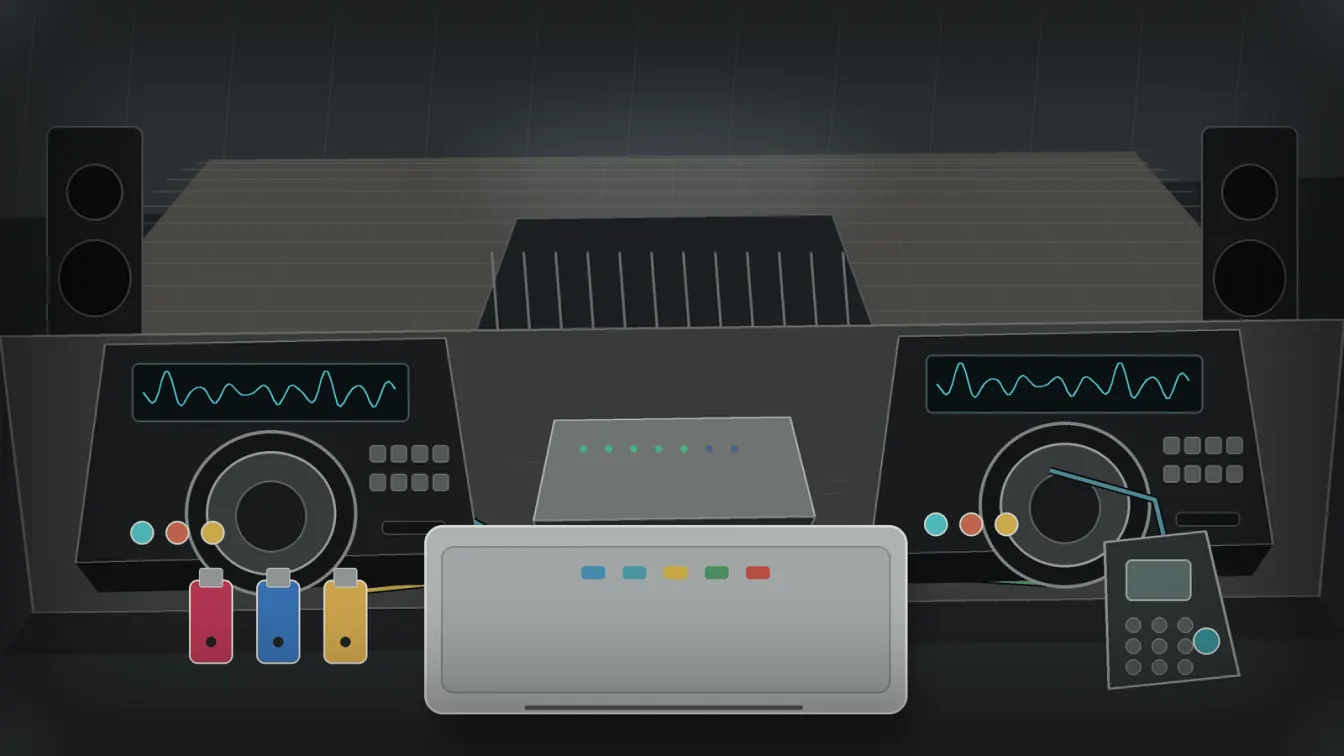
AlphaTheta has disclosed a security vulnerability in PRO DJ LINK, the network that lets rekordbox, CDJ/XDJ players, removable media, mixers, and performance tools exchange music and timing data inside a DJ booth. A third party who gains unauthorized access to that network may be able to view data stored on a connected Windows PC or Mac, or on USB and SD cards inserted into connected players.
The company published the warning on August 8 while fixes were still incomplete. Rekordbox 7 and 6 have partial repairs. The iOS and Android versions remain affected. Seven supported CDJ/XDJ player models and two all-in-one systems are waiting for firmware. AlphaTheta is withholding technical details until those fixes exist and says it has confirmed no cases of damage.
That leaves operators with an ugly interim fact. The cable carrying beat position, media discovery, track metadata, and remote loading also marks a security perimeter. Club booths routinely assemble that perimeter from venue gear, artist laptops, touring USB drives, unmanaged switches, wireless links, lighting systems, livestream computers, and third-party utilities minutes before a set.
the booth network was designed to share
PRO DJ LINK exists because sharing makes a booth playable. One USB drive can feed several players. A laptop running rekordbox in Export mode can serve tracks to the decks. Players exchange BPM, beat position, device state, media details, and commands. Mixers can synchronize effects. Lighting and livestream software can observe performance state.
DJ TechTools’ long-running setup guide describes a basic Ethernet network that can join players, rekordbox, phones, tablets, production gear, and third-party applications. The convenience depends on discovery. Devices arrive, announce themselves, claim identities, expose state, and accept the protocol traffic required to make the room behave like one instrument.
Independent implementations make that surface visible without revealing AlphaTheta’s withheld vulnerability. Deep Symmetry’s protocol analysis documents broadcast-heavy UDP traffic on ports 50000 through 50004 for device announcements, beat synchronization, media queries, detailed player status, track loading, and touch audio. Its tools can pose as a virtual CDJ to induce other devices to return richer state.
Prolink Tools turns the same behavior into useful software. It can monitor devices, build livestream overlays, and retrieve track metadata from rekordbox or media mounted in players. That project is legitimate, public, and valuable. It also proves the architectural point: participation in the booth network carries capabilities. The network needs an answer for which participant may exercise which capability.
AlphaTheta has disclosed only that path at a high level. It has not said how the attacker joins, which protocol operation fails, whether access is limited to indexed libraries, or whether the flaw exposes broader paths on a computer. Claims of arbitrary file access currently outrun the primary source. The verified scope is serious enough: unauthorized network access can lead to viewing data stored on computers and removable media attached to the performance system.
a trusted LAN is a weak security policy
The company’s immediate precautions are operational rather than cryptographic. Update every rekordbox client. Keep sensitive data off USB and SD cards used with PRO DJ LINK. Use secured, password-protected Wi-Fi. These steps reduce exposure, but they leave the central trust model intact while firmware work continues.
A password on the wireless access point controls one route into the network. It cannot establish the identity or authority of every device already inside. A venue technician may connect a livestream machine. A lighting operator may run a protocol bridge. An artist may plug a laptop into the switch for Link Export. A borrowed player may carry old firmware. A tour manager may hand over a USB drive prepared on a general-purpose computer. The network boundary moves with each cable and each set change.
This is normal backstage reality. Booths optimize for compatibility and fast recovery because dead air is a harder immediate failure than abstract data exposure. Flat local networking is forgiving when a replacement deck or guest laptop appears five minutes before doors. Authentication, network segmentation, certificate enrollment, and device policy all create failure modes that can stop a performance. Vendors defer that complexity until the trust assumption breaks in public.
The fix therefore has two jobs. It must close the undisclosed data-view path without breaking a mature interoperability system. It also has to reach hardware installed across clubs, festivals, studios, rental houses, and touring rigs. A desktop application can nag on launch. A CDJ may remain offline until somebody schedules maintenance, finds the right firmware, verifies USB compatibility, and accepts the risk of changing a machine whose primary virtue is that it worked last night.
the product matrix is the incident
AlphaTheta’s response matrix names seven affected player families: CDJ-3000X, CDJ-3000, CDJ-2000NXS2, CDJ-1500X, CDJ-900NXS, XDJ-1000MK2, and XDJ-700. The XDJ-AZ and XDJ-XZ all-in-one systems are also affected. Firmware fixes for all of them remain in progress.
Rekordbox 7 is partially fixed from version 7.2.17. Rekordbox 6 is partially fixed from version 6.8.7. Additional updates are planned for both. The mobile apps remain affected. Stagehand and PRO DJ LINK Bridge require no action. Several newer all-in-one products are listed as unaffected, though AlphaTheta plans associated security updates for them.
Models with PRO DJ LINK functionality missing from the matrix have reached end of support. That footnote matters. Club standards live longer than software support cycles, and older players do not vanish when a product page stops listing downloads. They move into smaller venues, rehearsal rooms, rental inventories, home studios, and backup rigs. AlphaTheta does not claim those devices are safe. It excludes them from the supported response.
5 Magazine’s specialist report correctly focuses on the mismatch between the warning and available repair. Operators are being told to update immediately while the official matrix labels the current desktop protection partial and most hardware fixes unfinished. A venue cannot patch its way to a complete state on the day of disclosure because the complete state has not shipped.
performance networks need an inventory
The practical response begins with boring custody. Venues and rental houses need a model-and-firmware inventory for every network-capable player and all-in-one unit. Rekordbox laptops should run current versions and avoid unrelated personal or business data. Performance USB drives should contain the library and export database required for the set, with recovery copies stored elsewhere. Booth wireless should use a dedicated protected network rather than a public venue SSID. Unneeded uplinks and mystery devices should stay off the switch.
Touring artists need a similar boundary. A music USB is performance media, not pocket storage for contracts, passport scans, tax records, stems under embargo, or a decade of unfiled chaos. A laptop serving Link Export should be treated like a stage machine. The network adapter, firewall policy, sharing services, and connected software deserve a preflight check alongside audio routing.
These controls sound severe only because club technology spent years disguising a networked computer system as a row of appliances. Modern decks discover peers, query databases, parse removable media, accept remote commands, synchronize state, connect to wireless services, and receive firmware. Their job is musical. Their failure modes belong to distributed systems and embedded security.
AlphaTheta’s eventual patch will decide whether this incident closes as a bounded implementation bug or exposes a deeper admission problem in PRO DJ LINK. The vendor has given no technical basis for choosing between those possibilities yet. The current evidence supports a narrower conclusion: a participant who should never have been trusted can see data the performance network should have protected, and the repair must cross software, mobile clients, embedded firmware, venue inventory, and unsupported hardware.
The booth was already a network. This disclosure forces everyone running one to admit it.