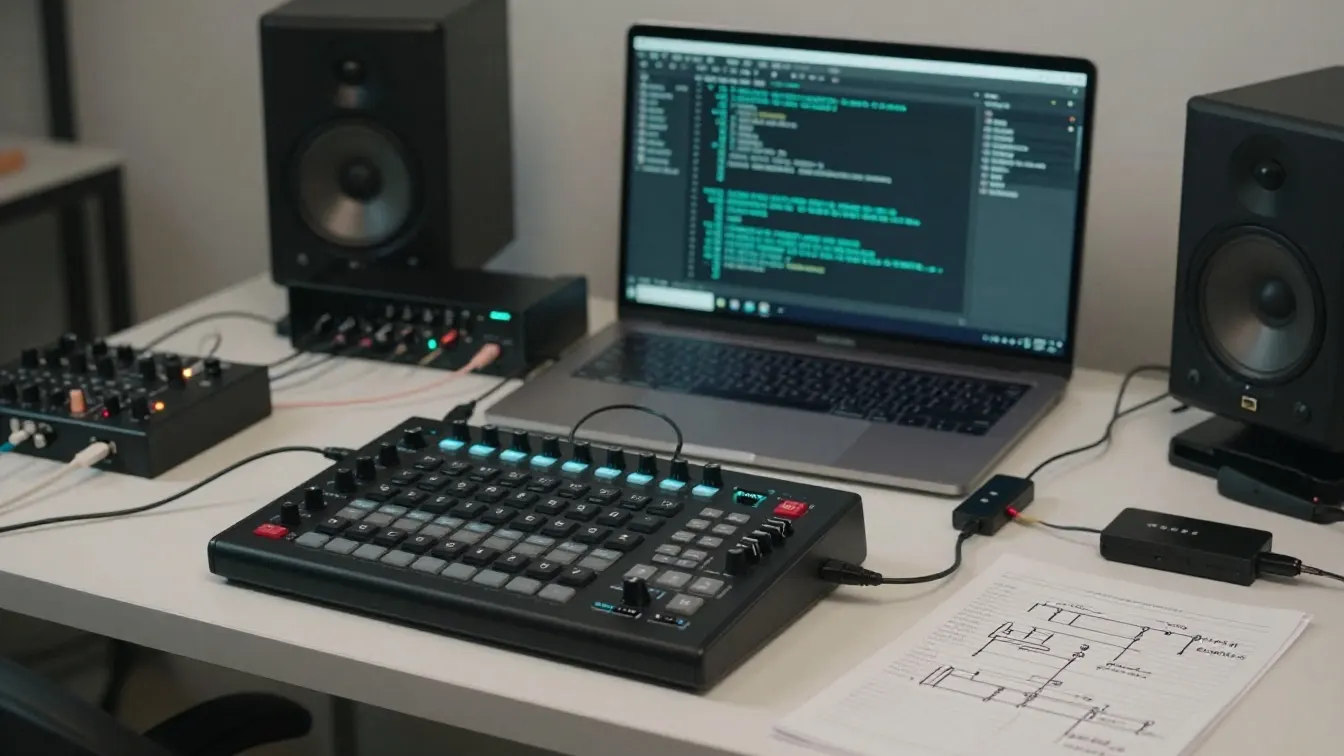
Ableton Push 3 Standalone contains a processor, battery, SSD, audio interface, Linux operating system, and a dedicated copy of Live. Ableton presents that stack as one finished instrument. Federico Pepe’s new Push Hack framework found the seams.
The prototype installs extra services over SSH, leaves the system partition alone, and reaches into the paths connecting Live to the display, buttons, pads, LEDs, MIDI ports, browser, and storage. It adds a mobile file manager, USB-drive support, a hardware-operated shadow interface, browser-drawn automation, system telemetry, and full display takeover. The result looks like a feature bundle. The useful artifact is the access model underneath it.
the appliance already had an extension surface
Ableton’s Push manual describes the standalone model as an instrument that works without a computer. Its processor and SSD run Live locally; Wi-Fi handles updates, Packs, cloud sync, file transfer, Link, and hotspot duties. The USB-A port accepts storage and class-compliant MIDI devices. The screen, pads, encoders, buttons, audio interface, CV outputs, and software form one controlled product surface.
Push Hack enters through an advanced route the device already exposes. The owner enables SSH, then an installer deploys modular services into the writable data partition. SysV init scripts register those services so they survive a reboot. The framework does not replace Ableton’s operating system or flash unofficial firmware. It runs beside the shipping software and hooks selected boundaries.
That distinction gives the project teeth. A total firmware replacement proves that hardware can run foreign code. A sidecar framework proves that the vendor’s working instrument can remain intact while owners add capabilities around it.
The first module, Push Manager, runs a web application directly on the device. A phone or computer on the same network can browse, upload, download, rename, copy, and delete files; search presets; move material through a USB drive; inspect system resources; and manipulate the display and LEDs. The local network becomes an unofficial management plane for an instrument that already contains the necessary storage and compute.
the screen hook reveals the real boundary
The sharpest part of Push Hack is a C shared library injected into the Push process through LD_PRELOAD. It intercepts libusb_bulk_transfer calls between the software and the XMOS coprocessor driving the display. In passthrough mode, Ableton’s interface renders normally. An overlay mode can add pixels to each frame. Full-takeover mode lets another service provide the entire image.
That hook produces the Shadow UI, an interface navigated with Push’s own jog wheel and directional controls. It can also stream drawings from a browser to the hardware screen at roughly ten frames per second. No separate display API was offered for this work. The project made one by intercepting the existing USB conversation.
MIDI gets a similar treatment. Push Manager can monitor events and block them before Live receives them. An intercept mode turns the controls into inputs for unofficial functions without triggering their normal actions. A forward mode routes events to the hardware MIDI output. The LEDs are addressable, including the reverse-engineered colour palette and animation behaviour.
A browser automation module then turns drawn curves into MIDI CC. It reads Live’s 24-pulse-per-quarter-note MIDI clock, follows transport from the Push play button, and loops as many as eight automation lanes using linear or Catmull-Rom interpolation. A surface designed for Ableton’s parameter model becomes a general control system without ceasing to be Push.
Live still owns one important thread
The preset browser exposes a clean limit. Push Manager can search Live’s library from the web or Shadow UI, but only Live’s engine can instantiate a preset on a track. The framework solves that boundary with a MIDI Remote Script. A local service sends the request over a loopback socket, and the script calls browser.load_item() on Live’s engine thread.
This is a tiny architectural confession. Filesystem access supplies the catalog. Network services supply the interface. Hardware hooks supply the controls. The proprietary application still owns object creation inside the running music engine.
The framework works because it respects that division instead of pretending every layer is equally open. Its modules route around closed surfaces where possible and bridge into the supported engine where necessary. That is better engineering than the usual hardware-hack theatre of boot logos and brittle demos.
ownership collides with the update channel
The prototype carries real risk. Its author says the project is unsupported, unsuitable for production use, and built substantially with coding agents under human supervision. Users are told to back up sets, samples, and files and to understand Ableton’s official recovery process before installing anything.
Software updates expose the most serious collision. Push Hack patches LD_PRELOAD into the Push 3 init script. The framework must be removed before an Ableton update and reinstalled afterward. Starting an update while the hook remains installed can freeze the device with a blank screen and dead controls, forcing a hard shutdown.
This failure mode does not make the experiment pointless. It identifies the cost of an unofficial extension surface with unusual precision. The owner can reach the computer, but the lifecycle belongs to the vendor. Durable customization needs stable hooks, versioned interfaces, service isolation, and an update process that can identify third-party components before replacing system state.
Create Digital Music’s launch report makes the obvious product argument: Ableton could support some of this officially. Novation, monome, and community projects around Ableton Move have already shown what documented or tolerated extensibility can produce. Push Hack adds a stronger proof because it controls the full standalone stack: display, files, presets, MIDI, LEDs, automation, and on-device navigation.
The project also makes a harder governance claim. Creative hardware now ships as networked general-purpose computers with carefully limited public personalities. Manufacturers decide whether the owner receives an SDK, a scripting layer, a recovery image, a shell, or a sealed appliance. Those are policy choices expressed as architecture.
A musical instrument earns longevity through accumulated technique. A computer earns longevity through adaptation. Push 3 contains both kinds of object. Push Hack forces Ableton’s finished product to admit the second one.