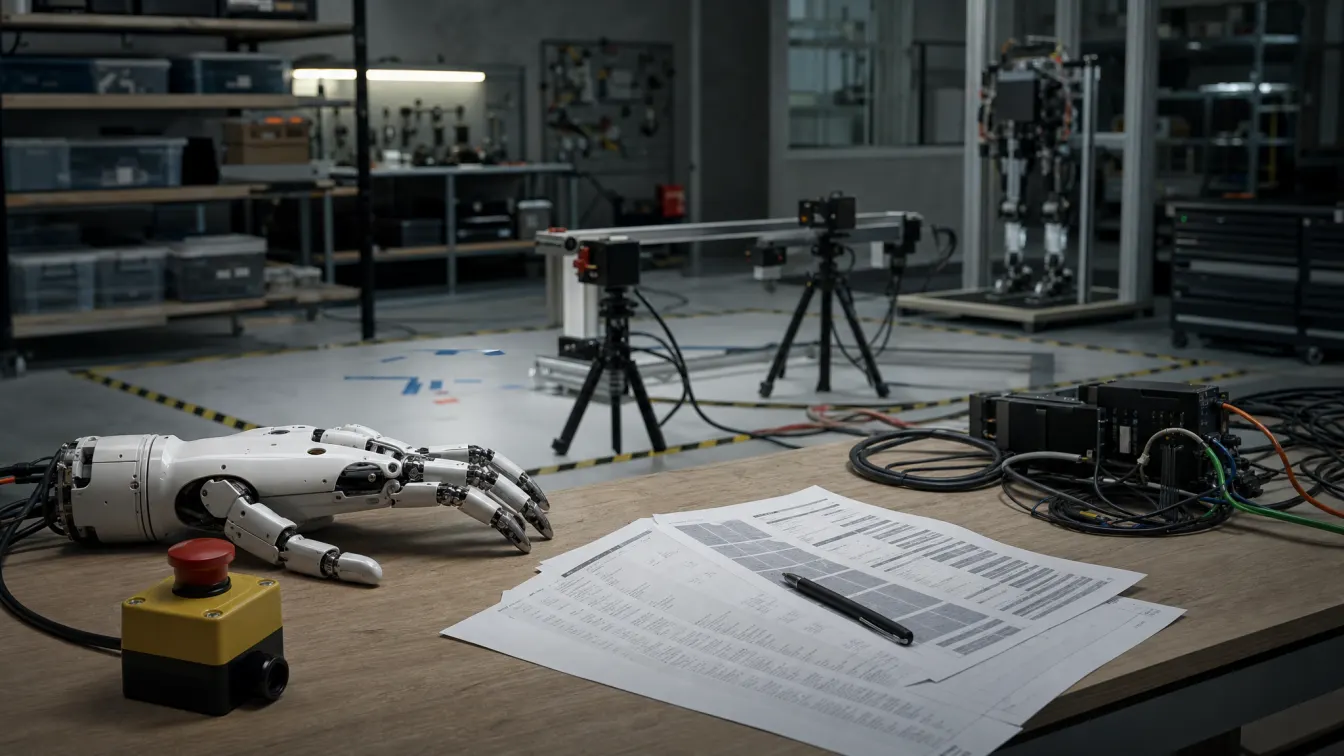
Google DeepMind shipped Gemini Robotics 2 on July 30. The strongest signal is the stack diagram hiding inside the product page: embodied reasoning above motor control, a vision-language-action model below it, an on-device variant for local hardware, partner gates around the most dangerous pieces, and a safety benchmark trying to evaluate whether the reasoning layer can refuse a bad physical action before metal moves.
This sits next to The FCC Made Robots a Supply-Chain Border, but the new development is different. The FCC story was about market admission for connected machines. DeepMind’s release is about runtime admission: which command reaches the body, which model plans the sequence, which policy controls the hands, and which safety call stops the machine when a person enters the work area.
the body now has a model stack
DeepMind describes Gemini Robotics 2 as a family of three models. Gemini Robotics ER 2 is the embodied reasoning layer. It watches, plans, tracks progress, coordinates with humans or other robots, and can call lower-level robot tools. Gemini Robotics 2 is the vision-language-action model that converts camera input and language into robot actions. Gemini Robotics On-Device 2 is the efficient local version for hardware that cannot rely on a clean network path.
That split matters because robotics already had layers: perception, planning, control, safety interlocks, telemetry, hardware drivers. The AI story becomes serious when those layers turn into model interfaces. A reasoning model can stream live video and decide the next step. A VLA policy can transform that plan into full-body movement. A local model can keep operating when cloud latency or connectivity makes remote inference unacceptable. Each boundary becomes a place where access control, logging, override, evaluation, and liability have to live.
DeepMind says the new VLA can control robots of different shapes, from arms to full humanoids. The page claims whole-body control from feet to fingertips, including balance while stepping, squatting, and bending in cluttered spaces. Ars Technica’s writeup adds the practical access split: ER 2 is available to developers through the Gemini Live API, while the VLA and on-device models stay limited to a smaller trusted-tester group.
success rates are the honest part
The benchmark numbers make the announcement better because they puncture the usual humanoid theater. DeepMind’s own charts show whole-body manipulation on Apollo with Inspire hands at 68.4 percent for picking up from a table, 45.7 percent for picking up from the floor, and 76.3 percent for picking up from a shelf. Multi-finger dexterity on Apollo with Sharpa hands swings from 92 percent for unscrewing a bulb to 32 percent for a dustpan task. Franka Duo gripper work lands higher, with 89.6 percent on precise insertion and 78.9 percent on diverse tool kitting.
Those numbers are the story. A humanoid can look magical in a cropped video and still fail enough routine tasks to be operationally weird. A warehouse, lab, hospital, factory, or home-care setting cannot average away a dropped object, a bad reach, a confused recovery step, or a balance correction near a human. The 60-point spread across fine-motor tasks says the system is capable and brittle in the same breath.
That brittleness changes product design. Robots need obvious local stop paths, restricted work zones, staged autonomy, operator-visible confidence, post-action logs, and boring human override. The companies that sell this as general magic deserve every lawsuit they eventually collect. The companies that sell it as a constrained runtime with measured envelopes might survive contact with floors, hands, cables, carts, pets, union reps, and physics.
the safety benchmark is an admission
DeepMind’s responsibility page says the robotics models combine human-robot interaction safeguards, semantic safety, physical safety mechanisms, vulnerability assessment, and decision transparency. The most revealing line is careful: human-proximity stopping remains ongoing research without a safety-rated guarantee. Good. That sentence carries more truth than a dozen cinematic videos.
Ars reports that DeepMind released a new ASIMOV-Agentic safety benchmark with Gemini Robotics 2. The test evaluates whether an embodied reasoning agent refuses unsafe tool calls from the VLA layer, decides whether a task can be performed safely, and asks for human assistance when uncertain. That is the right target. The failure mode includes the malicious prompt, then keeps going into plausible tasks routed through a body that lacks enough certainty to execute.
The term “tool call” gets uglier when the tool has elbows. A browser agent clicking the wrong button can burn money or leak data. A robot taking the wrong tool call can pinch a hand, drop glass, crush a cable, block a doorway, or enter an emergency scene. This is where agent safety stops being content moderation with nicer graphs. It becomes industrial control with probabilistic planning upstream.
partner access is governance by distribution
DeepMind lists Agile Robots, Apptronik, and Boston Dynamics as research partners, with over 100 trusted testers from enterprise automation companies and robotics startups. That is staged distribution. ER 2 can be tried through Google AI Studio and the Gemini API, but the action-producing models stay inside a narrower program.
That gate will irritate open access absolutists. It should. It should also irritate anyone who has watched platforms use safety as a moat. Both instincts can be true without flattening the issue into tribal slop. Full motor control for humanoid hardware is too consequential for a casual API free-for-all. A single company deciding who receives the strongest physical-control policy also becomes a private regulator for a new hardware software layer.
The durable fight will be over the artifacts around that access: evaluation results, incident reporting, operator controls, data-retention terms, hardware compatibility, emergency stops, audit logs, model update notice, simulator coverage, and the contract that decides when the cloud can change behavior on a machine sitting in someone else’s building.
the real product is permissioned embodiment
Gemini Robotics 2 is a clean marker for where physical AI is heading. The model has moved past the chat box and into runtime components inside machines with weight, reach, sensors, network dependencies, and vendor-managed updates. The governance question follows the wire: who can call the model, who can approve the action model, who can update the policy, who sees the logs, who owns the incident, and who can force the machine to stop.
The demos will get all the attention because humanoids are catnip for people with no resistance to theater. Fine. Let them clap at the robot. The systems story is colder and better: DeepMind just made the interface between reasoning and motion visible. That interface is where safety, platform power, labor deployment, industrial procurement, and liability will fight each other for the next decade.