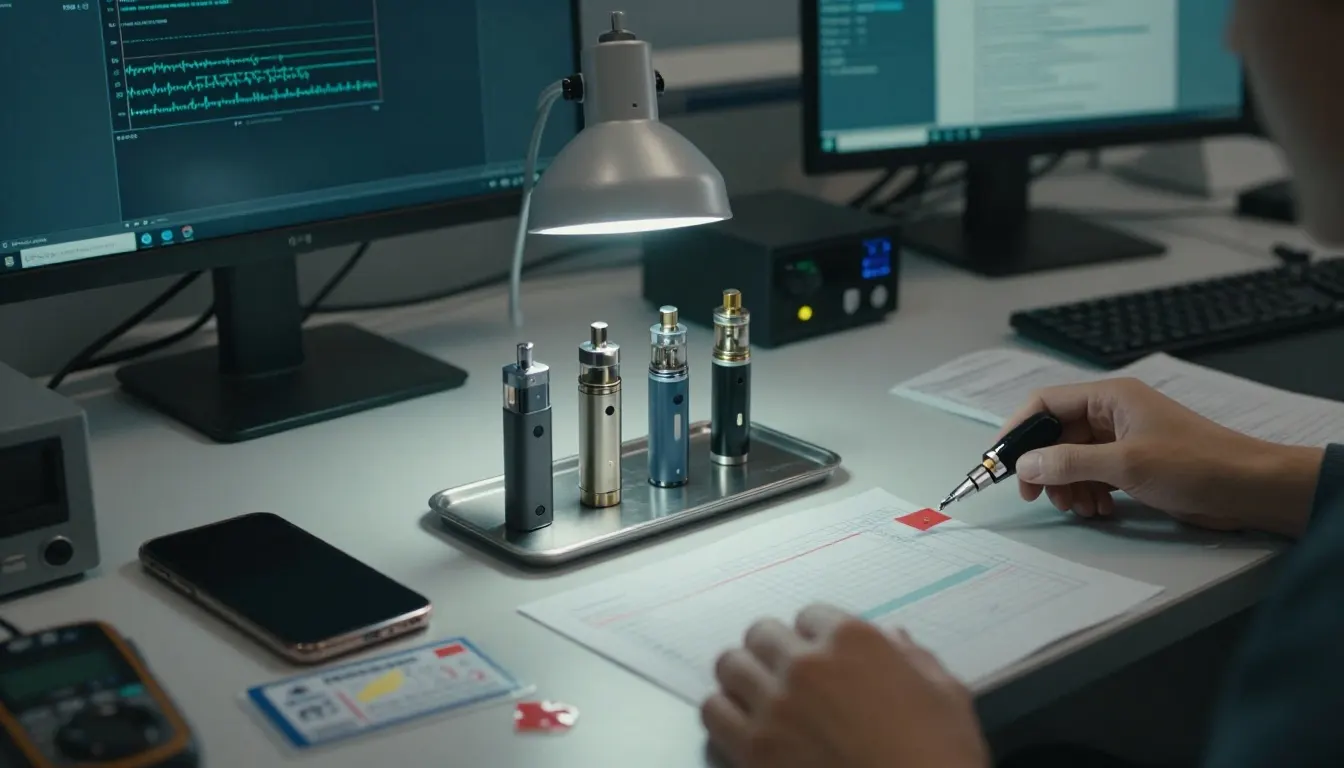
The FDA authorized JUUL2 for sale in the United States on August 28. The decision covers the device and tobacco- and menthol-flavored pods at roughly 1.6% nicotine. It also returns Juul to the market with a different object from the cigarette-shaped USB stick that became a national argument about teen vaping.
JUUL2 is a connected permission system. Its optional app can verify that a user is 21 or older, pair to the device over Bluetooth, show battery and pod levels, locate the vape, track product use, and lock it. Each pod carries a secure ID chip that authenticates consumables and blocks unauthorized compatible pods. A nicotine device now arrives with identity, location, telemetry, firmware, and cartridge admission attached.
That stack gives Juul a clean regulatory story. Adult smokers get a lower-risk alternative to combustible cigarettes. Parents and owners get a lock. Counterfeit pods lose access to the heater. Regulators get a product with legible controls. The machinery also centralizes authority inside Juul’s app, approved pod catalog, verification vendor, and account layer.
FDA authorized the health claim around the hardware
The FDA’s public decision rests on population health. Its review found that 19.9% to 34.6% of study participants using the tobacco pod had stopped smoking cigarettes entirely at six weeks. The range for the menthol pod was 28.4% to 49.3%. People who switched completely showed lower exposure to harmful chemicals than people who continued smoking combustible cigarettes.
Those numbers matter because the statutory test weighs benefit to adults who smoke against risk to young people and non-users. The agency found the menthol pod’s switching benefit sufficient to outweigh its risks, including youth appeal. It has now authorized 48 e-cigarette products.
Authorization remains a marketing order, with the FDA explicitly withholding approval or endorsement. The agency’s August 28 release describes the device, flavors, nicotine concentration, switching data, and population-health standard. It does not present the optional app lock as the basis of its finding.
Juul’s own announcement does. The company places the app, PodID chip, heater controls, device lock, location, and product-use insights inside a single “next generation” platform. That framing matters. A regulatory decision about lower chemical exposure becomes commercial permission for an account-linked hardware system.
Age verification is available, then optional
JUUL2 can require an online age check before unlocking. The proposed verification flow described when Juul filed the product in 2023 used a government ID plus a live selfie, or a third-party database check against submitted personal information. After verification, the app can pair with the device and manage its lock.
The lock is voluntary. Reporting on the original application said pods would not ship automatically locked, and the current company announcement calls the 21+ app optional. This produces a peculiar control boundary. The system can collect enough evidence to connect an adult identity to a physical nicotine device, yet the strongest youth-access control still depends on the verified adult choosing to activate and retain it.
Retail age checks govern the first sale. App verification governs account enrollment. Device lock governs later possession. These are separate events. A compliant purchase does not prove a compliant handoff, and a verified account does not prove that the paired object remains with the verified person. The device can enforce possession policy only while its owner keeps the policy switched on.
Calling this an age-verified vape compresses the first three rows into one reassuring phrase. The actual system distributes responsibility among retailer, identity provider, account holder, phone, Bluetooth pairing, and device state. Any serious evaluation needs to measure how many buyers enable the lock, how often it remains enabled, how recovery works when a phone disappears, whether an adult can pair multiple devices, and how resale or household transfer is handled.
The FDA release publishes switching percentages. Juul publishes product features. Neither public statement gives adoption or retention data for the lock because the U.S. rollout has barely begun. The enforcement claim therefore starts as capability, not observed behavior.
Pod identity creates a private consumables border
The secure PodID chip does two jobs. Juul says it improves vapor performance and prevents illegal counterfeit pods. Authentication can protect heater settings and block unknown liquid from entering a controlled thermal system. The same mechanism gives the manufacturer final authority over compatible consumables.
That border will become commercially important if Juul follows through on planned filings for 5% nicotine products and flavors beyond tobacco and menthol. Every newly authorized pod can become a signed object admitted by hardware already in the field. Every unauthorized producer stays outside the device, regardless of whether its cartridge physically fits.
This resembles printer ink, game-console peripherals, and phone accessories, with nicotine regulation supplying a stronger justification. Safety, dosage, counterfeit prevention, product quality, and FDA authorization all favor authenticated pods. Competition, repair, consumer modification, and independent testing favor visibility into the admission rule. The chip turns those arguments into firmware behavior.
A regulator can authorize individual tobacco products. A manufacturer-controlled hardware root decides which authorized or unauthorized objects actually run. Public law and private authentication meet at the pod socket.
The vape becomes a data relationship
Juul says the app provides product-use insights, device location, real-time battery state, and pod-level information. Each feature can serve a practical function. Device location can recover a lost vape. Usage history can help an adult understand consumption. Pod data can warn about supply and compatibility.
Together they create an intimate telemetry surface around addiction. Frequency, time, pod turnover, location, account identity, and device state can reveal routines that a disposable vape never knew. The public materials do not specify retention, sharing, deletion, law-enforcement access, breach handling, offline behavior, or whether core device functions will survive discontinued app support.
Those questions belong in the product’s public-health evaluation because connected controls age. Phones lose operating-system support. Verification vendors change. Bluetooth stacks fail. Accounts get locked. Companies are acquired. Servers disappear. A device sold as harm-reduction hardware can outlive the service that makes its safety controls intelligible.
Juul has an obvious incentive to make this system durable. The company paid roughly $3 billion to settle government and private litigation over teen use, lost its position as the leading U.S. e-cigarette brand, and now trails Vuse while unauthorized flavored disposables dominate continuing youth use. JUUL2 is a route back through technical governability: fewer flavors, lower nicotine concentration, authenticated pods, measurable switching, and a visible age-control feature.
The regulatory bargain deserves harder instrumentation than a feature list. Publish lock activation and retention rates. Document failed and disputed age checks. Separate safety telemetry from marketing data. State the offline contract. Expose the pod-authentication lifecycle. Guarantee export and deletion for usage history. Commit to a shutdown path that leaves lawful adult owners with functional hardware instead of a dead permission token.
JUUL2 moves nicotine governance into software. The quality of that governance will be measured in defaults, data custody, revocation, compatibility, and service life. An app icon cannot carry the weight by itself.