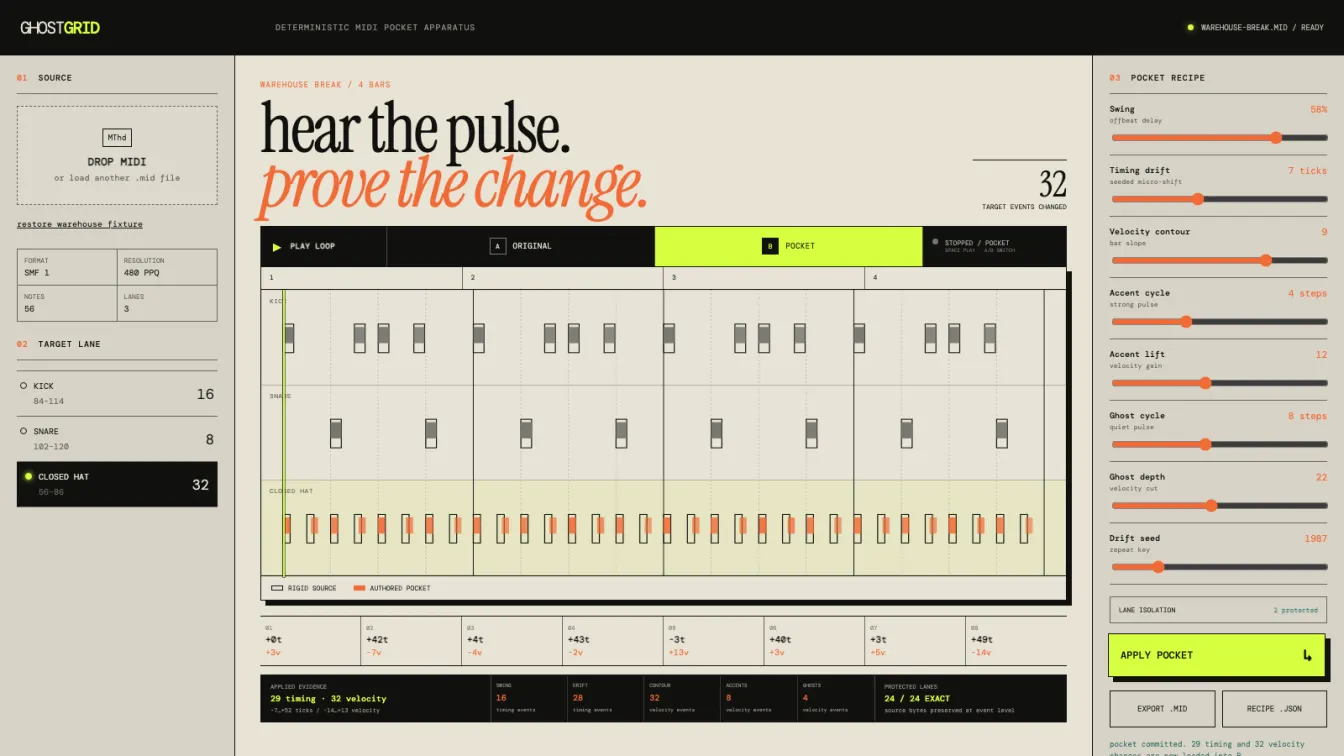
Ghost Grid MIDI gives electronic music producers a controlled way to pull rigid drum programming into a repeatable pocket. Load a Standard MIDI File, isolate a kick, snare, or closed-hat lane, then shape swing, timing drift, velocity contour, accent cycles, and ghost-note depth. Every other lane stays protected.
The included four-bar warehouse break makes the workflow immediate. Press play once, then switch between the rigid source and authored pocket without restarting the loop. Original events remain visible as outlines while transformed notes appear as solid marks under the same moving playhead. The applied-evidence ledger reports the exact timing and velocity range, how many events each active control affected, and whether every protected lane stayed exact. A changed slider is marked unapplied until the pocket is committed.
Four systems drive daily-2026-07-22-ghost-grid-midi:
- Real MIDI parsing and lane isolation. The browser reads Standard MIDI Files, identifies note lanes, PPQ, globally ordered tempo maps, time signatures, tracks, and end-of-track timing, then limits mutations to the selected pitch. Preview timing integrates every tempo segment, and export preserves that metadata instead of flattening the file to one BPM. The source fixture contains 56 notes across three drum lanes.
- Deterministic pocket authoring. Swing, drift, contour, accents, ghosts, and seed feed one transformation path. Accent and ghost cycles count events in the selected lane, while swing delays alternating selected hits. Identical source bytes and recipe values produce identical note events. The regression suite proves each material control changes its promised domain independently.
- Synchronized audible A/B. A Web Audio drum engine schedules original and transformed MIDI events against one transport. Switching A/B preserves loop position, making timing and velocity differences audible in place instead of asking the event plot to carry the entire argument.
- DAW-ready export. The tool writes a Standard MIDI File plus a JSON recipe. The committed validator checks SMF structure, note pairing, fixture inventory, protected lanes, meaningful edits, and parser/writer round-trip behavior before the file is treated as valid.
The interface is built as a compact production instrument. Source and lane selection sit on the left, the before/after event field occupies the center, and the pocket recipe stays reachable on the right. Desktop exposes the whole machine at once. Mobile preserves the same primary workflow without turning the controls into a disconnected settings page.
Everything runs locally in the browser. Uploaded MIDI never leaves the machine. The live release was verified by starting its audio context, scheduling the loop, switching from pocket to original while playback continued, applying the recipe, exporting the resulting .mid, and running the committed validator against the downloaded file. GitHub now repeats the full browser workflow on every push.