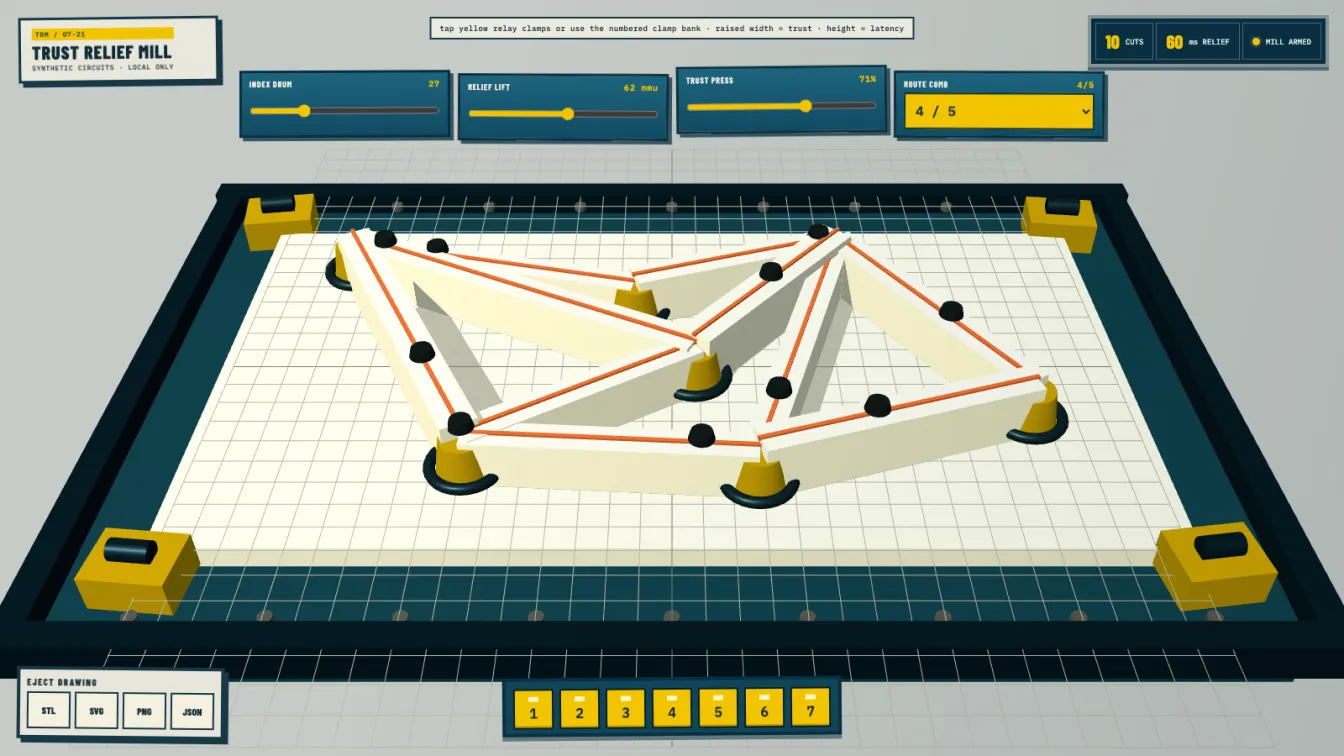
Trust Relief Mill converts synthetic trust routes into a ceramic-looking relief plate on a bright cobalt CNC bed. Route width carries trust. Raised height carries latency. Seven yellow relay clamps let you isolate paths directly, while Index Drum, Relief Lift, Trust Press, and Route Comb reshape the circuit into deterministic fabrication geometry.
Select a relay from the numbered clamp bank, tap clamps on the bed, or move through the controls by keyboard. Every change rebuilds the route network and updates the animated carriers moving across it. Four circuit recipes provide useful starting geometries, and the current machine state survives reloads through local storage.
Three interacting systems drive the mill:
- Selectable Three.js routing geometry. Seven relay clamps feed an extruded network of trust and latency routes. Direct selection changes the visible topology, while allocation-free carrier animation keeps motion stable inside the WebGL scene.
- Deterministic machine controls. Index Drum, Relief Lift, Trust Press, and Route Comb mutate one reproducible circuit recipe rather than applying decorative camera effects. Keyboard relay isolation and local persistence make the apparatus usable without an account.
- Fabrication export. The same route state produces ASCII STL for printing, a clean SVG plan, a PNG renderer proof, and a JSON recipe. Automated QA opens each export and verifies its bytes or required structure instead of trusting a download button that merely exists.
Preact owns the controls, persistence, and deterministic state transitions. Three.js handles the high-angle milling bed, extruded route meshes, clamps, lighting, and carrier motion. TypeScript keeps the geometry and export contracts explicit. Vite supplies a compact static build that can live under a GitHub Pages repository path.
The main tradeoff is geometric clarity over physical simulation. This is not a slicer and it does not model tool chatter, ceramic shrinkage, or printer tolerances. It produces a deterministic relief artifact whose visual encoding and exported topology share one source state. That makes it useful for exploring routes, comparing recipes, and carrying a chosen result into a real fabrication workflow.
Everything runs locally in the browser and collects no user data. Playwright verifies the 1600×900 desktop frame, 375×812 mobile layout, 44-pixel touch targets, keyboard controls, state persistence, all four export formats, and zero console errors.