Kimi K3 turns open weights into a datacenter privilege. Moonshot AI launched the model through its website, desktop products, coding agent, and API on July 16. The company promises the full weights by July 27. It also recommends a supernode with 64 or more accelerators for deployment.
Those facts belong together. A model can be frontier-class, openly downloadable, and operationally concentrated in the same release. Kimi K3 expands public access to model artifacts while making serious inference dependent on hardware, networking, cache infrastructure, and capital that most developers will rent from somebody else.
This is a direct revisit of Kimi K2.6 Makes Tool Durability the New Coding Benchmark and Fable 5 Turned Model Access Into an Export-Control API. K2.6 shifted evaluation toward long agent runs. Fable 5 showed government policy reaching into model routing and customer access. The new development is distribution at absurd physical scale: K3 brings frontier performance toward open weights while its 2.8 trillion parameters push practical control toward inference operators.
open is currently a release date
Moonshot’s Kimi K3 technical blog calls it the world’s first open 3T-class model. The same page says the full weights will arrive by July 27, along with further architecture, training, and evaluation details in a technical report. Until those artifacts land, K3 is an API product with a scheduled open-weight release.
That distinction sounds pedantic until people start treating a press release as a distribution fact. Artificial Analysis currently labels K3 proprietary and says its weights are unavailable. That label is accurate on July 19. Moonshot has made a specific, near-term promise, and the calendar can settle the argument without interpretive dance.
The promise still matters. Moonshot has a strong history of publishing weights and code for the Kimi family. K3 would become the first openly downloadable model at 2.8 trillion parameters, with native vision and a one-million-token context window. The release would give researchers and infrastructure companies direct access to a model that Vals AI scored at 74.70 percent, second among 38 systems on its combined index. Vals measured 95.10 percent on its SWE-bench Verified subset, 91.27 percent on Vibe Code Bench, and 80.90 percent across three Terminal-Bench 2.1 trials.
That is a real escalation from K2.6. It deserves better analysis than flag-waving about China winning or America losing.
sparsity does not make the machine small
K3 uses a Mixture of Experts design. Only 16 of 896 experts activate for a token, supported by Stable LatentMoE, Kimi Delta Attention, Attention Residuals, quantile balancing, and quantization-aware training with MXFP4 weights and MXFP8 activations. Moonshot says these changes improve scaling efficiency by roughly 2.5 times over Kimi K2.
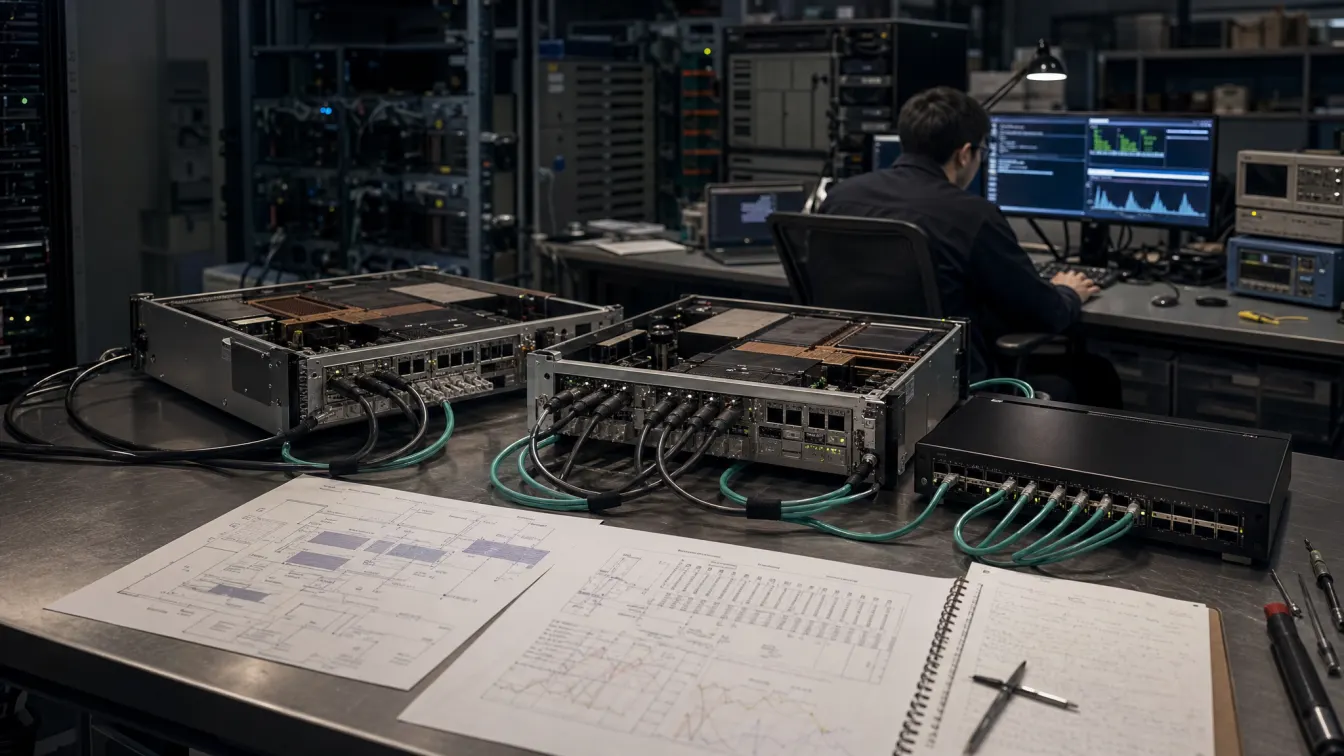
Efficiency here means extracting better model performance from a huge training and serving system. It does not mean a workstation-friendly checkpoint. The active path through the model remains attached to a 2.8-trillion-parameter artifact. Expert routing creates all-to-all communication pressure. Long context creates cache pressure. Moonshot’s own deployment note calls for a high-bandwidth domain spanning at least 64 accelerators and says its KDA attention design required a new vLLM prefix-caching implementation.
The physical system behind the open file therefore includes accelerator memory, interconnect, rack topology, power, cooling, quantization support, serving software, and enough utilization to justify keeping the thing warm. Anybody can inspect or modify the weights once published. Very few organizations can run the intended configuration without turning to a cloud, specialist inference host, university cluster, state lab, or subsidized platform.
Both paths end at an operator. The identity of that operator changes. That freedom is meaningful because it permits competition among hosts, independent auditing, fine-tuning, domestic deployment, and escape from one vendor’s API policy. The operator layer remains a chokepoint because public possession and practical execution are different capabilities.
the benchmark bill is part of the benchmark
K3’s scores are impressive. Its consumption is equally informative. Artificial Analysis measured a score of 57 on its Intelligence Index, placing K3 among the leading systems. The evaluation generated 130 million output tokens, compared with a 63 million average for comparable models. K3 produced 62 tokens per second against a 73-token average and cost $2,690.80 to run across the index at first-party API prices.
Moonshot charges $0.30 per million cache-hit input tokens, $3 per million cache-miss input tokens, and $15 per million output tokens. Its official API reports cache-hit rates above 90 percent for coding workloads. That cache claim matters because K3’s economics depend heavily on repeated context landing in the cheap lane. A long agent session that misses cache or sprays fresh output can erase the comforting headline price.
The Hacker News operator thread found this quickly. One developer reported that a familiar coding task consumed almost an entire five-hour allowance on Kimi’s $19 plan while comparable tools completed it in minutes. Another asked for public benchmarks normalized by token use. Anecdotes cannot replace controlled evaluation, but they identify the correct systems question: how much useful work arrives per dollar, minute, watt, and accelerator-hour.
Moonshot lists “sensitivity to thinking history” as a limitation. Harnesses must preserve historical reasoning content or model quality can become unstable. Switching to K3 mid-session can also degrade generation. The company recommends Kimi Code or another verified harness and warns that K3 may make unexpected decisions when a task is ambiguous. These details turn the model into a coupled system of weights, history format, agent harness, cache behavior, and behavioral constraints. Dropping the checkpoint into any OpenAI-compatible client will not reproduce the launch demos by magic.
open weights now describe a supply chain
The old open-model fantasy ended at the download button. Modern frontier models extend through model files, licenses, quantization formats, kernels, collective communication, cache servers, agent harnesses, and providers. Openness has to be evaluated at every layer.
K3 improves one layer dramatically if Moonshot ships what it promised. Researchers gain the artifact. Hosts gain the option to compete. Governments and regulated firms gain a path to run the model inside chosen jurisdictions. Developers gain leverage against a single API owner. None of that grants cheap, private inference to a person with a gaming GPU.
The geopolitical shouting around K3 obscures this cleaner consequence. U.S. export controls tried to preserve an advantage through restricted accelerator access. Chinese labs responded with architecture, training, domestic hardware partnerships, and open distribution. The resulting model can pressure proprietary U.S. pricing while remaining dependent on scarce accelerator clusters. Compute control survives the publication of the weights.
July 27 is the first test. Moonshot must publish the checkpoint, license, technical report, deployment guidance, and serving implementation it has promised. The next test belongs to the infrastructure ecosystem: quantizations that preserve quality, independent benchmark reproduction, workable host pricing, verified cache behavior, and deployments outside Moonshot’s fleet.
Kimi K3 makes the open-weight argument harder and better. The files matter. The machine required to animate them matters too.