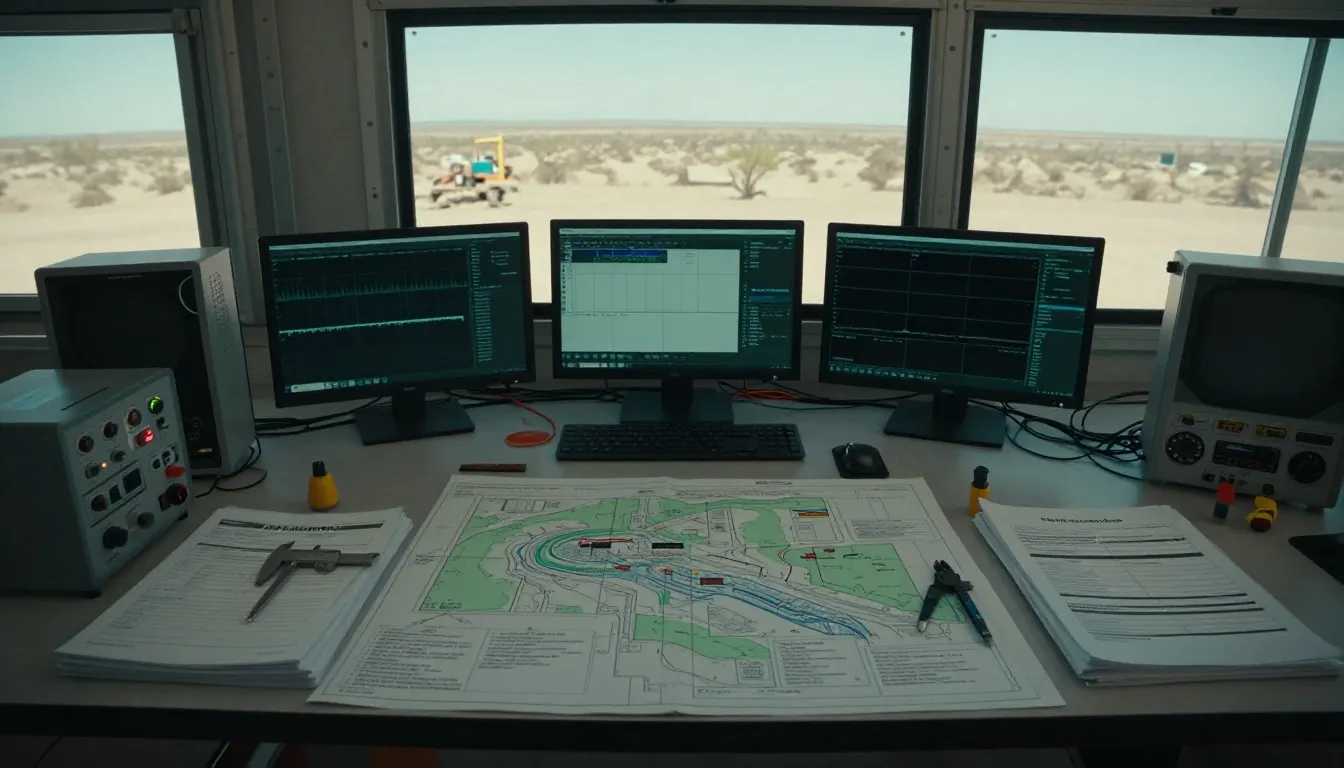
Amazon has attached its next AI campus to a private power system on the edge of the Permian Basin. The plan joins three newly registered data-center buildings with GW Ranch, a gas-fired generation project approved for 35 turbines and up to 7.65 gigawatts in Pecos County, Texas. The plant’s permit allows 33.2 million tons of carbon dioxide equivalent per year.
This revisits AI Datacenters Made the Utility Bill a Control Surface and DOE Turned Cleanup Land Into AI Power Real Estate. The new development is Amazon’s identification in the physical record. Texas construction registrations filed August 4 name Amazon Data Services as owner of the data-center buildings. Amazon then confirmed that it acquired the GW Ranch site and plans to buy power from the Pacifico Energy plant.
A company spokesperson says the private grid will keep the campus from raising electricity costs for Texas families. That claim addresses one ledger. The air permit opens several others.
the bypass is the product
Pacifico markets GW Ranch around speed. Its project page says the campus can bypass interconnection processes and regulatory bottlenecks, deliver first power in the first quarter of 2027, reach one gigawatt in 2028, and exceed five gigawatts by 2031. The company promises a private grid with no ERCOT load, no new utility transmission lines, and no effect on consumer electricity prices.
The Texas Commission on Environmental Quality describes the same machine in harder terms. Permit numbers 181033, PSDTX1672, and GHGPSDTX255 cover a greenfield simple-cycle gas plant about 17 miles north of Fort Stockton. The agency’s preliminary determination lists 35 turbines, wet-surface air coolers, heaters, emergency engines, tanks, fuel piping, maintenance activity, and a nominal 5,000-megawatt output. It says the plant will serve an on-site AI data center and will initially be incapable of buying from or selling to the local utility system.
That isolation solves a commercial delay. Grid interconnection queues can strand a campus for years while utilities study generation, transmission, substations, and cost allocation. A private plant turns fuel access, turbine procurement, air permission, and construction sequencing into the critical path. Cleanview has identified 59 behind-the-meter data-center projects totaling roughly 90 gigawatts. Ninety-two percent of that announced capacity appeared since the beginning of 2025.
Speed explains the equipment choice. Cleanview reports that efficient heavy-duty combined-cycle turbines face long lead times, so developers are buying simple-cycle turbines, engines, and whatever else can arrive. AI data centers can generate enough revenue per megawatt that earlier energization outweighs years of inferior fuel efficiency. GW Ranch’s permit authorizes the turbines to run 8,760 hours per year when calculating maximum annual emissions. The infrastructure is designed around immediate compute admission, with efficiency left to the future stack of solar, batteries, grid service, and promised carbon capture readiness.
paying the power bill does not settle the account
Amazon’s strongest claim is narrow and credible on its own terms. A self-funded private plant avoids charging ERCOT ratepayers for transmission and generation built specifically for this campus. The project also avoids consuming a scarce queue position while it operates independently.
The permit records the displaced cost with unusual clarity. Proposed annual limits include 33,162,721 tons of carbon dioxide, 2,830 tons of nitrogen oxides, 5,955 tons of carbon monoxide, about 991 tons of fine particulate matter, 1,925 tons of ammonia, and smaller quantities of sulfur dioxide, volatile organic compounds, sulfuric acid, methane, and nitrous oxide. Maximum carbon dioxide equivalent reaches 33,204,964 tons per year. Actual operations may sit below those ceilings. The permit defines the legal operating envelope, which is the relevant governance object before the plant has an operating history.
The plant’s independence also has a stated expiration condition. Amazon says the campus is designed to transition to grid-connected service when interconnection timelines allow. Private generation therefore acts as a bridge into future public-grid participation. The company can bring compute online before ERCOT is ready, then seek a connection after the campus, fuel supply, and economic constituency already exist.
the carbon pledge now shares a site plan with 35 turbines
Amazon’s 2025 sustainability report says companywide emissions rose from 65.28 million metric tons of carbon dioxide equivalent in 2023 to 69.55 million in 2024 and 80.85 million in 2025. The report keeps the 2040 net-zero target and says AI is creating new energy, water, and infrastructure demand. GW Ranch gives that sentence a permitted maximum and a construction address.
The annual permit ceiling would equal roughly 41 percent of Amazon’s reported 2025 companywide footprint. That comparison describes scale, not a forecast. Permit limits assume operating conditions that facilities rarely sustain across every unit for an entire year, and the project’s delivered output may evolve. Still, the ratio exposes the size of the choice. One campus can acquire a pollution envelope comparable to a large fraction of the company’s current global emissions before its first server powers on.
Pacifico lists up to 750 megawatts of solar and 1.8 gigawatts of battery storage beside the gas system. Those assets can shift output and reduce some fuel use. They do not change the plant’s basic admission logic. The gas turbines provide dispatchable power on the accelerated schedule; solar and batteries live inside a system whose air permit assumes continuous combustion is possible.
The water claim deserves the same precision. Amazon says the campus will use non-potable brackish groundwater unsuitable for drinking or irrigation. Pacifico says the project needs no major external water source. That avoids a direct municipal-water demand. It leaves groundwater pumping, cooling design, discharge, chemistry, and long-term monitoring as local physical questions. “Self-supplied” names ownership of the intake. It says nothing by itself about aquifer behavior.
private infrastructure still requires public permission
Behind-the-meter generation changes the institutions that can slow an AI campus. A utility commission loses immediate leverage over service timing and cost allocation. The air regulator gains weight because generation permission becomes the admission gate. County officials, groundwater authorities, pipeline operators, equipment suppliers, and emissions monitors become part of the compute control plane.
That shift is spreading because the grid cannot match the buildout’s desired tempo. Cleanview counts only about two gigawatts of behind-the-meter capacity operating today, with most of the 90-gigawatt announced pipeline still permitted, planned, or speculative. GW Ranch stands out because the air permit is issued, construction registrations are public, land clearing is visible, and Amazon has confirmed its role. The project has crossed several thresholds that separate industrial execution from datacenter fan fiction.
The public argument now needs better accounting than “Amazon pays” or “AI uses too much power.” Amazon can fund its own plant and still create a huge climate liability. Texas can protect current ratepayers and still authorize pollution. Pacifico can avoid ERCOT and still depend on public air law, groundwater governance, pipelines, emergency services, roads, and eventual interconnection. Each claim can be accurate while the combined machine remains brutal.
The old grid made a hyperscaler negotiate its appetite through a shared system. GW Ranch gives Amazon a private lane from Permian gas to AI compute. The lane ends at the meter. Its emissions, water, land, equipment, and future interconnection remain in the world the rest of us inhabit.