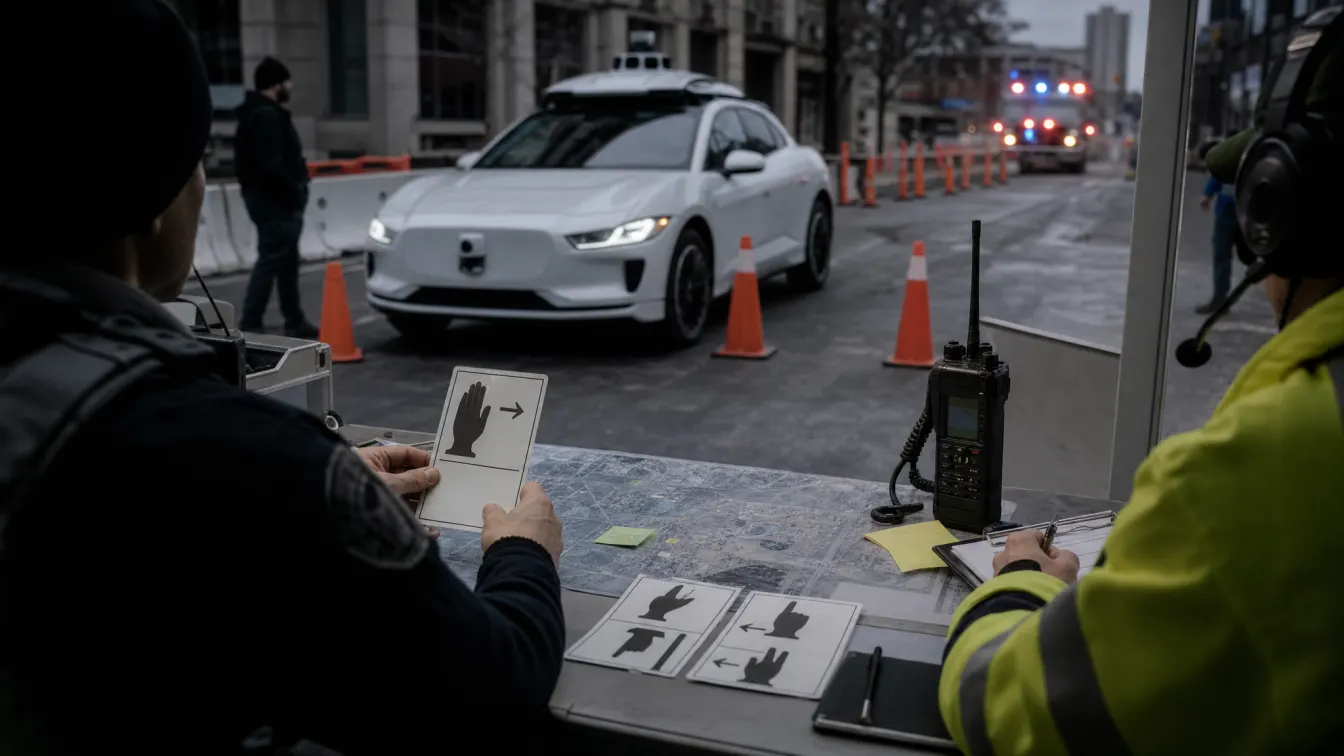
Robotaxis turn emergency scenes into undefined behavior. The National Highway Traffic Safety Administration says driverless vehicles have driven into active incidents, blocked ambulances and fire apparatus, missed flashing lights and flares, and failed to follow human traffic control. These are ordinary street conditions with ugly timing. A vehicle that needs a clean lane, a current map, and a predictable gesture vocabulary becomes dead weight exactly when the city is under pressure.
NHTSA Administrator Jonathan Morrison called the pattern a “functional insufficiency” in a July 8 letter to automated-driving developers. The agency will meet driverless-system operators by the end of July to hear their fixes and has threatened enforcement against companies that leave significant safety defects unresolved. The Department of Transportation recirculated the warning this week, pushing a familiar local complaint into a federal deadline.
This directly revisits Waymo Made the Taxi a Reporting Device. That post examined the fleet’s power inside the cabin: cameras, support escalation, remote stopping, account sanctions, and police contact. The new development sits outside the car. NHTSA has identified a cross-operator safety pattern, and first responders describe robotaxis obstructing active emergencies even after years of training programs and company procedures. The control problem has moved from passenger governance to street protocol.
the street stops behaving like a benchmark
Emergency scenes destroy the assumptions that make automated driving tractable. Lanes close without notice. A firefighter parks against traffic. An officer points through a red light, waves one vehicle around a motorcycle, then stops the next. Smoke obscures markings. Cones move. Ambulances approach from the wrong side. A shooting, gas leak, flood, funeral procession, or fallen utility line can rewrite the street faster than a fleet map updates.
Human drivers screw this up too. The law can fine or jail them for impeding responders, and an officer can knock on the window, make eye contact, shout, point, or take the keys. A driverless vehicle replaces that negotiation with perception models, policy logic, fleet connectivity, remote assistance, and a phone number. Every layer can be individually sensible while the whole system occupies the ambulance lane.
WIRED reported that Austin responders described Waymos freezing in difficult situations and missing hand signals. San Francisco’s fire chief said the vehicles were frequently blocking fire-station access. During a downtown Austin mass shooting, a robotaxi blocked an ambulance for two minutes. TechCrunch found at least six incidents through March in which responders had to take control of Waymo vehicles and move them out of traffic.
Two minutes is interface latency when somebody is bleeding.
the hotline is a private control plane
Waymo’s first-responder program is substantial. The company says it has trained over 35,000 responders at more than 150 agencies, operates a dedicated emergency number, publishes vehicle-specific response guides, and supports remote unlocking and manual disengagement. Its 2024 program review by TÜV SÜD found the process consistent with SAE best practices. Waymo said closed-course tests covered emergency vehicles, sirens, officer hand signals, accident scenes, and secure manual takeover.
The paperwork is ahead of the street.
The Police Executive Research Forum’s 2025 report on autonomous vehicles and policing describes the operational gap in brutal detail. Austin used computer-aided dispatch email to warn companies about critical fires, then found police incidents too dynamic for the same method. Officers suggested monitoring a public social feed for phrases such as “barricaded subject” and “active shooter.” San Francisco dispatchers sent geofence notices when transit buses were rerouted. Phoenix police had to phone companies to establish event closures. Officers warned that they could not retain separate takeover procedures for 50 operators.
That is a homemade federation protocol assembled from email, social posts, dispatch calls, fleet hotlines, and vehicle manuals. It works until urgency, network failure, operator confusion, stale geometry, or vendor diversity tears it apart.
A private hotline also reverses authority. The officer standing in the road must identify the vehicle, call its owner, describe the scene, and wait for the fleet to act. Public emergency command becomes a request to a remote corporate control plane. The fleet may be responsive. The dependency remains stupid.
cities need an emergency protocol, not fifty training decks
A usable protocol needs machine and human surfaces. Dispatch systems should publish authenticated incident zones with geometry, severity, permitted approach directions, expiry, and responder authority. Fleets should acknowledge receipt, expose which vehicles are affected, enter a conservative yield state, and report when every vehicle has cleared. Responders still need a universal local override that works without mobile coverage or vendor-specific memory.
The hard part is authentication. A spoofed incident message could empty streets, redirect fleets, isolate a target, or create a traffic weapon. The protocol needs signed agency credentials, short-lived commands, replay protection, jurisdiction limits, audit logs, and a degraded mode for broken connectivity. Authority must be narrow enough that one compromised dispatch account cannot become a metropolitan steering wheel.
Gestures still matter. A cop pointing around a crash is carrying high-bandwidth local context that no polygon contains. Driverless systems need a standardized responder gesture set and a clear failure response. When confidence collapses, the vehicle should stop somewhere that preserves responder access, announce its state externally, and accept a universal takeover method. Freezing in the only lane is cowardice encoded as safety.
federal pressure needs measurable behavior
NHTSA’s letter gets the category right. Emergency interaction belongs in the base safety case. The agency’s remedy is still vague. It asks companies to bring solutions by month’s end without publishing acceptance criteria, response-time limits, scenario coverage, incident reporting fields, or consequences for silence.
A competent standard would test live scenes rather than polished demonstrations. It would measure detection and clearance under smoke, glare, occlusion, conflicting hand signals, moved cones, dead cellular service, blocked GPS, multiple responding agencies, and simultaneous fleet incidents. It would count how long a vehicle blocks the route, how often remote assistance intervenes, how often an officer takes manual control, and how quickly geofences propagate. Fleet operators should publish those failures by city and scenario.
The regulatory contradiction is useful. NHTSA is simultaneously removing equipment assumptions that presume a human driver, including requirements around mirrors, controls, wipers, and warning labels, while telling operators that responder interaction remains a mandatory human boundary. Purpose-built robotaxis can lose steering wheels. The public cannot lose a reliable way to command the machine occupying the road.
The robotaxi industry sells autonomy as removal of the driver. Emergency response reveals the institution that replaces them: fleet operations, dispatch feeds, geofences, remote specialists, city agreements, federal recalls, and a stack of procedures that must converge before a car moves ten feet. That machinery is now part of the street.
A city cannot delegate emergency right-of-way to vendor goodwill and laminated PDFs. The road needs one command language, one override grammar, and public evidence that the machines obey when the normal map catches fire.