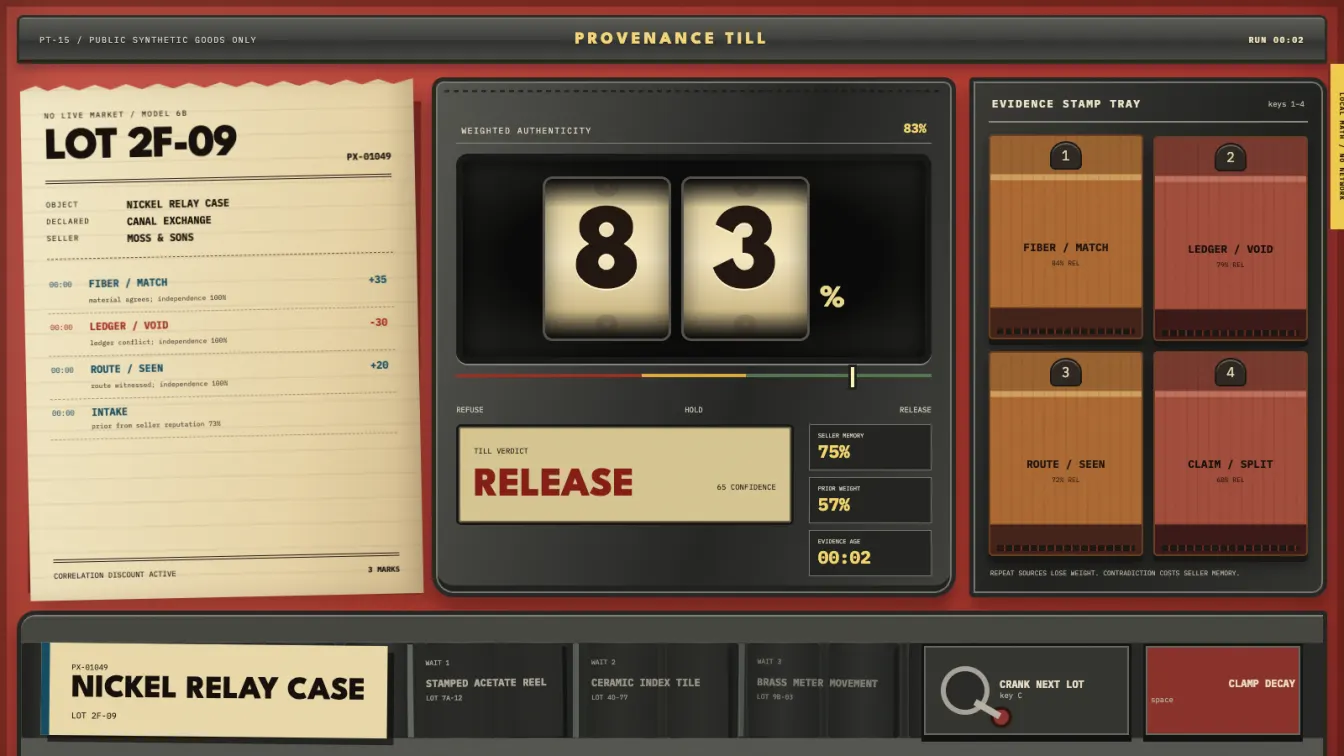
Provenance Till turns counterfeit-market evidence into a battered red shop machine. Each synthetic consignment arrives with a seller, material claim, route, asking price, and evidence ledger. Stamp the lot as material agreement, origin conflict, motive signal, or chain split. The cream numeral drums roll toward an authenticity score, the verdict register decides whether to release or quarantine it, and the thermal receipt preserves the reasoning.
The interaction is deliberately physical. Number keys strike the four evidence stamps, C cranks in the next lot, and the controls remain usable by pointer, touch, or keyboard. A rotating queue keeps new tickets moving across the conveyor while reputation and confidence continue evolving in the background. No marketplace account, payment data, network request, or user tracking enters the machine. Everything is synthetic and local.
Three coupled systems drive the till:
- Bayesian authenticity scoring. Every evidence item carries reliability and direction. The engine updates the lot’s odds while discounting repeated claims from correlated sources, preventing five copies of one rumor from masquerading as five independent facts.
- Seller reputation with decay. Reputation changes how strongly the machine trusts a consignment, then drifts as time advances. Old credibility cannot remain permanent collateral, and a bad run leaves a visible mark on later lots.
- A mechanical audit surface. Evidence stamps, rolling score drums, a verdict register, queue tickets, and a thermal receipt expose each state transition. The mechanism stays readable instead of collapsing into a generic dashboard.
Vue 3 keeps the physical controls and derived state synchronized without burying the scoring model inside component markup. TypeScript gives the evidence graph, lots, sellers, and update rules explicit shapes. The rendering uses DOM and CSS rather than Canvas because the till depends on crisp text, accessible buttons, keyboard focus, and responsive reflow more than freeform pixels. That choice also makes the fake enamel, torn paper, rubber stamps, inset drums, and conveyor hardware cheap to layer and easy to inspect.
The tradeoff is theatrical density. A real scoring model needs enough information to justify its verdict, while a convincing till wants chunky hardware and immediate feedback. The layout gives the receipt, score drums, and stamp tray most of the frame, then compresses queue and control detail into the lower machinery. On mobile, the same pieces stack without shrinking touch targets below 44 pixels or introducing horizontal scroll.
Playwright exercises both the 1600×900 instrument and a 375-pixel mobile viewport. It strikes evidence, changes lots, tests keyboard focus, checks text clipping and touch targets, watches console errors, and captures the exact app state used above. The result is a provenance model you can operate with your hands, even though every object passing through it is imaginary.