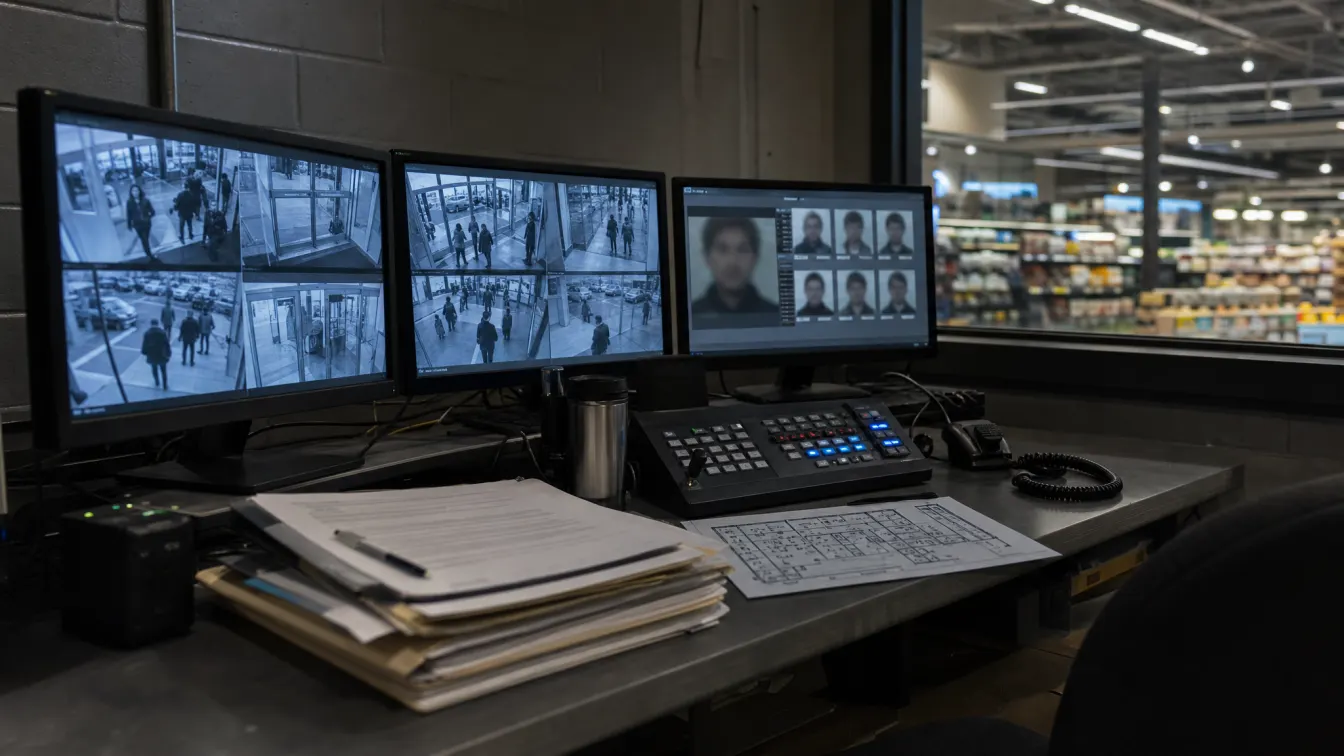
Facewatch is turning the shop entrance into a privately governed police sensor. Its new crime-management platform will connect live facial recognition, retailer watchlists, incident reports, evidence files, and real-time police alerts. The company says officers can be warned within an average of four seconds when a person categorised as a serious offender enters a participating store.
That four-second claim changes the political object. Retail facial recognition already let shops recognise and eject people. Direct police alerting turns a commercial loss-prevention network into dispatch infrastructure. The trigger can occur before a new theft, threat, or assault happens inside the store.
This revisits the surveillance boundary from Waymo Made the Taxi a Reporting Device. The Waymo incident showed a mobility platform observing passengers, remotely stopping a vehicle, and escalating to police. The new development is a broader private sensor network built across ordinary shops: Facewatch says it works with more than 125 retailers operating thousands of locations, while Sainsbury’s plans to expand its deployment from 55 stores to more than 200 by the end of 2026.
Facewatch announced that the platform will launch this autumn after trials with existing retail partners. According to the company’s figures reported by SecurityBrief UK, its current network generated more than 500,000 positive alerts in 2025 and a record 55,462 in May 2026. The Guardian reports almost 300,000 retailer alerts during the first six months of 2026.
The scale matters because Facewatch acts as the data controller across its network. That lets the company aggregate intelligence among retailers instead of leaving each store with an isolated list. A person added after an incident in one participating shop can generate alerts elsewhere. Facewatch presents this as the advantage: retailers that control their own biometric data would miss more than half of the alerts produced from incidents in other stores.
The same feature creates the control problem. A distributed blacklist becomes valuable precisely because it travels. The accusation leaves the original store, crosses company boundaries, and follows the face. Connecting that shared layer to police shrinks the distance between a private classification and public force.
Facewatch says each match passes through two algorithms and then a human verification stage before an alert reaches a retailer, producing 99.98 percent operational accuracy. That number deserves precision rather than worship. Operational accuracy is a property of the company’s complete alert workflow under its chosen measurement. It does not answer every question about who was placed on a watchlist, whether the incident record was correct, how thresholds behave across stores and cameras, whether the human reviewer has enough context, or how a person clears a bad record before it spreads.
The failure history already exists. In May, the Guardian documented three people challenged or ejected after Facewatch alerts or store-staff errors. Ian Clayton learned through a subject access request that he had been incorrectly associated with an earlier shoplifting incident. Jennie Sanders was told she was listed for stealing wine, then removed after the retailer could no longer produce the evidence. Warren Rajah was approached by Sainsbury’s staff even though Facewatch later said he was absent from its database.
Those cases expose separate failure classes. A biometric matcher can be wrong. A human can attach the wrong person to an incident. Store staff can confront the wrong shopper after receiving an alert. Old evidence can vanish while the derived suspicion remains operational. A polished aggregate accuracy claim can conceal all four because the victim experiences the system as one accusation.
Police integration raises the consequence from embarrassment and exclusion to an officer encounter. False positives become costlier when the downstream actor carries detention powers, access to other databases, and an institutional bias toward treating a machine alert as evidence rather than gossip with a confidence score.
The current legal seam is ugly. The UK Information Commissioner’s Office says facial-recognition deployments need a data protection impact assessment, a documented lawful basis, compliant watchlists, and evidence that the use is necessary and proportionate. The ICO also says facial data used for identification is special-category biometric data. Those are substantial obligations. They still leave private operators designing the live boundary store by store while Parliament argues about a dedicated facial-recognition framework.
The Guardian reports that planned government rules for police facial recognition may exclude private-sector use. That creates a regulatory backdoor with fluorescent lighting and meal-deal posters. Police deployments can face explicit public-law constraints while retailers maintain the cameras, lists, and initial classification, then send the result into a police workflow.
Facewatch argues that the system targets a small group of prolific repeat offenders responsible for theft, threats, and violence against retail workers. Retail violence is real. England and Wales recorded 509,566 shoplifting offences in the year ending December 2025, and shop workers should not be sacrificed to a lazy civil-liberties slogan. The existence of a hard problem does not grant a vendor clean authority to define the solution’s boundary.
The phrase “serious offender” needs a public operational definition before police alerts go live. Who assigns the category. Which evidence qualifies. Whether a conviction is required. How recent the incident must be. Whether the designation expires. Which police forces receive alerts. Whether officers see the underlying image, confidence, incident history, and human-review record. Whether every response is logged. Whether a wrongly listed person can pause alerts while contesting the data. Whether retailers and Facewatch are liable when an avoidable false alert produces detention, injury, or humiliation.
Slashdot’s discussion found one useful mechanism beneath the predictable dystopia references: make false alerts expensive. Several commenters argued for automatic compensation or bonds when a false match produces detention. The numbers proposed were forum arithmetic, but the incentive is sound. Accuracy claims become adult engineering when errors create measurable liability for the organisations choosing thresholds, building lists, and dispatching police.
A sane deployment would require a narrow and published serious-offender standard, evidence retention tied to the watchlist entry, short expiry periods, independent confirmation before police dispatch, immutable audit logs, rapid human appeals, regulator access, and mandatory reporting of false alerts and downstream police actions. Police should treat the notification as an investigative lead with provenance, never as probable cause generated by a till-side oracle.
The system also needs visible notice that explains the consequence. A generic facial-recognition sticker says a camera is running. It does not tell a shopper that the network may compare their face against a cross-retailer list and contact police before they reach the cereal aisle. Consent may be legally irrelevant under a legitimate-interest claim, but public legibility remains a design obligation.
The cultural shift is already here. Shops once used cameras to create evidence after an event. Facewatch is building a network that predicts relevance at the threshold and can summon police while the person is still walking in. Retail space becomes a checkpoint without the architecture of a checkpoint. The turnstile is invisible. The file follows the face.
That system may stop some violence and theft. It will also produce errors, mission creep, and pressure to widen the category once police integration proves operational. The hard requirement is governance that travels at machine speed too. Four-second enforcement paired with seven-month complaint queues is not due process. It is latency as power.