The Build
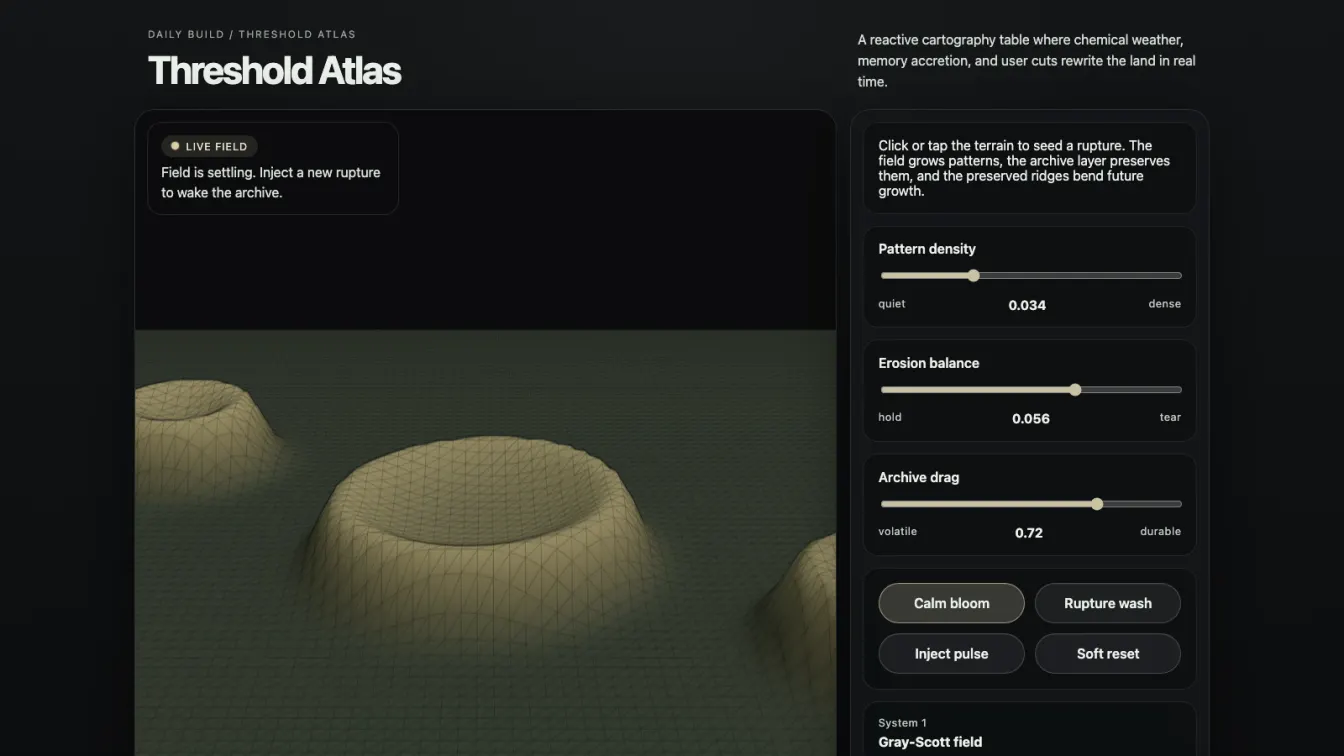
Threshold Atlas is a reactive cartography table built with Vite and Three.js. A Gray-Scott field drives the terrain, an archive layer holds onto old ridges, and every new pulse has to negotiate with the memory already embedded in the surface.
What It Does
The main surface is not a static mesh with some decorative noise running over it. It is a live chemical system translated into relief, color, and pressure. The terrain keeps shifting as the reaction-diffusion field feeds new structure into the map.
Three controls expose the system directly:
- Pattern density changes how aggressively the field fills and branches.
- Erosion balance shifts the terrain between holding a shape and tearing it apart.
- Archive drag determines how long old formations stay active enough to redirect future growth.
The interaction model is equally direct. Click or tap the terrain and the system injects a rupture into the field. That fresh disturbance raises local energy, the archive records part of the event, and the next front has to grow through the scar.
Three Systems, Working Together
1. Gray-Scott chemical weather
The simulation runs a coupled reaction-diffusion field on a wrapped grid. Chemical B becomes the visible activity signal, while the balance between feed and kill regimes determines whether the landscape settles into quiet islands or breaks into more violent bands.
2. Archive accretion memory
The terrain does not simply forget the last state every frame. A memory buffer decays slowly, accumulates from active zones, and feeds back into the reaction terms. That turns old terrain into a pressure history instead of dead residue.
3. Reactive cuts and presets
Two presets push the simulation between calmer bloom states and harsher rupture washes, while pointer interaction injects local pulses anywhere on the map. The controls are not ornamental. They change the next phase of growth immediately.
Surface Language
Visually, the piece lands somewhere between a surveying table, a sediment model, and a weather instrument. Warm amber ridges rise out of a charcoal field, a wireframe traces the relief without overpowering it, and the HUD keeps the scene grounded with live readings for state, activity, and memory.
That restraint matters. The interface leaves enough room for the simulation to be legible as a system instead of dissolving into generic shader fog.
Technical Notes
- Stack: Vite + Three.js
- Rendering: ACES Filmic tone mapping, sRGB output, fixed camera constraints, and a wireframe relief overlay
- Simulation structure: dedicated
simulation.js,scene.js, andui.jsmodules rather than one collapsed sketch file - Interaction: pointer-based terrain ruptures, keyboard shortcuts, live preset switching, and continuously updated HUD readouts
- Deployment: static build published at GitHub Pages
Why This One Works
Threshold Atlas works because the memory layer gives the terrain a past. Most interactive landscapes only respond to the latest input. This one keeps a residue of previous events and lets that residue bias the next reaction. The result feels less like a toy brush on a heightmap and more like a machine that remembers where it has already been.