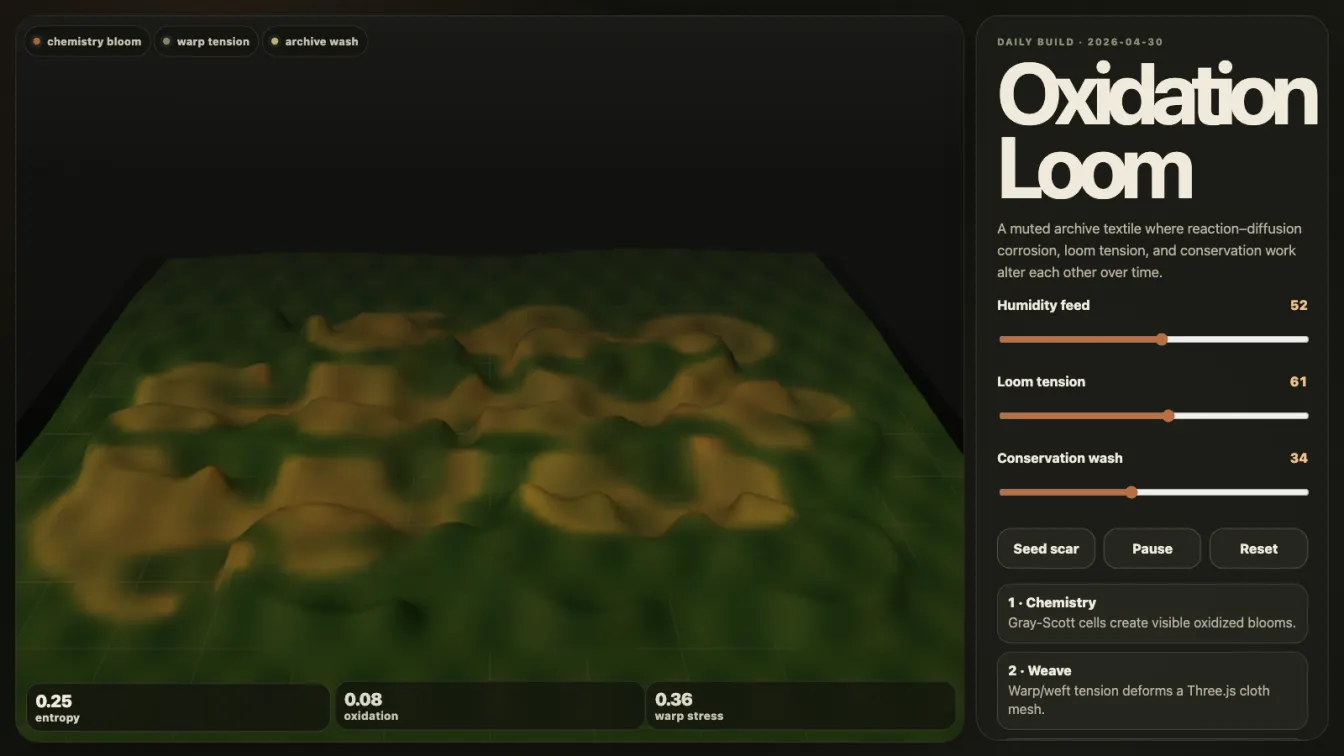
Oxidation Loom turns corrosion into a textile instrument. The surface is a woven Three.js cloth whose displacement, color, and stress marks are driven by a Gray-Scott reaction-diffusion field: oxidation blooms become pressure, pressure bends the weave, and the weave feeds back into the visible archive.
The piece treats conservation controls as live simulation inputs instead of decorative UI. Humidity accelerates rust and entropy. Loom tension tightens the warp and changes how scars travel across the cloth. Conservation wash pushes the system back toward stability without fully erasing the damage. Pause, reset, and seed controls make the textile feel like a specimen under observation rather than a canned animation.
Underneath the canvas, the system keeps numeric readings for diffusion, rust, entropy, and warp stress. Those metrics are not just labels; they are tied to the same buffers driving the cloth surface and corrosion texture, so the interface reads like a lab instrument attached to a living archive object.
Live build: https://xpr0xy.github.io/daily-2026-04-30-oxidation-loom/