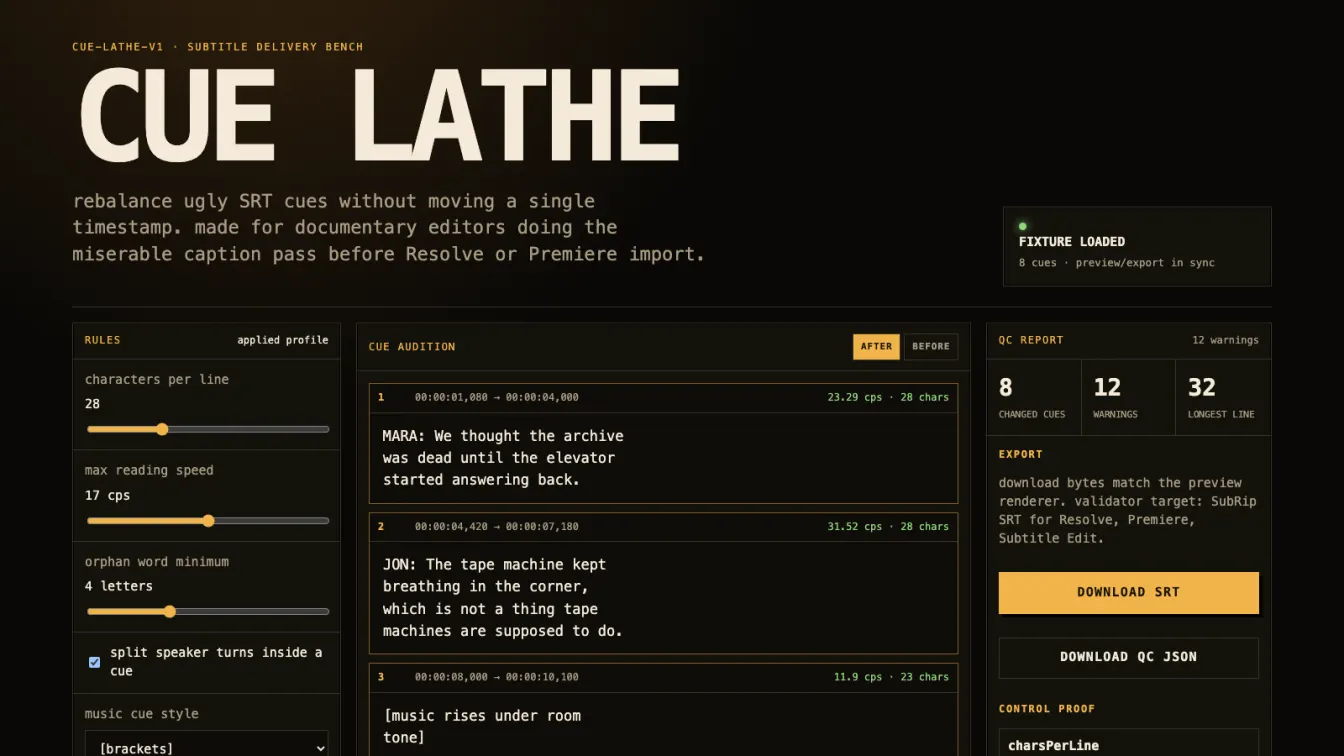
Cue Lathe is for documentary editors and assistant editors staring at rough-cut SubRip captions after the timeline is already sensitive. The job is ugly but common: make captions readable, split speaker turns, mark music cues consistently, flag impossible reading speed, and export something a delivery chain can parse without accidentally moving the edit.
The fixture is a real rough-cut SRT path through the tool. Load it, tune line length, reading-speed threshold, orphan-word handling, speaker-turn splitting, and music cue notation, then apply the rules explicitly. Changed controls stay pending until applied, because silent auto-mutating export tools are how subtitle mistakes sneak into the handoff.
Project marker: cue-lathe-v1.
Four systems define daily-2026-07-23-cue-lathe:
- Timing-preserving caption rewriting. Cue start and end times stay locked while text is reflowed into delivery-shaped lines. The tool changes caption body structure, not picture timing.
- Material rule controls. Line length, reading-speed warnings, orphan-word minimum, speaker-turn splitting, and music cue notation each affect the canonical fixture independently. The export is not a decorative preview with sliders taped to it.
- Before/after editorial review. Source and transformed cues sit together so an editor can inspect wording, warnings, and applied state before exporting. The workflow is built around review, not blind conversion.
- Parser-ready SubRip output. Export writes
rebalanced-captions.srtplus QC evidence. The committed validator checks SubRip structure, timing preservation, cue count, text transformation, warning evidence, and downstream-safe formatting.
The downstream target is boring in the correct way: DaVinci Resolve, Adobe Premiere Pro, Subtitle Edit, and any parser expecting SubRip SRT. That is the point. Caption delivery is not asking for a theme park. It wants exact bytes, stable timing, and a repeatable path from rough cut to handoff.
The live release was verified by opening the published browser app, running the canonical fixture through the workflow, exporting the SRT bytes, and rerunning the committed validator against the live output.