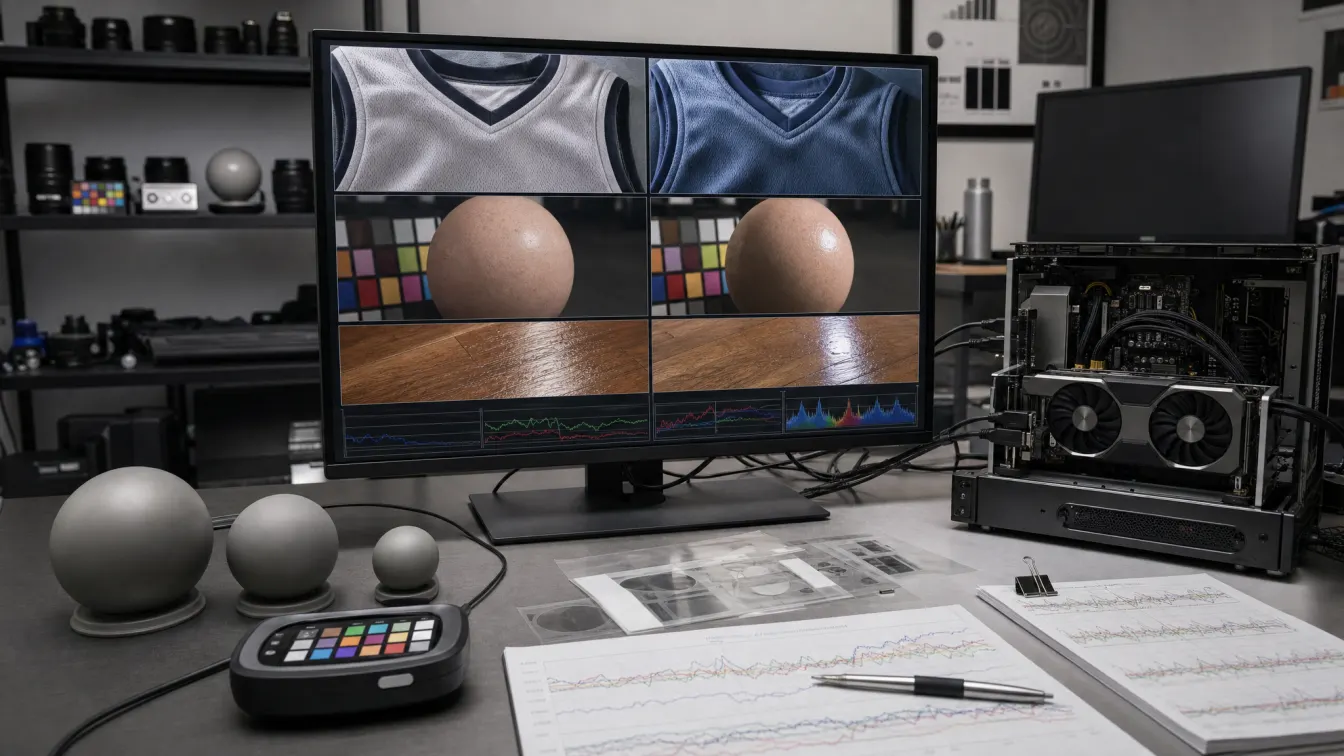
At 9 PM Pacific tonight, NBA 2K27 becomes the first shipping game with Nvidia DLSS 5. The feature takes the frame produced by the game engine, reads its color, motion, albedo, lighting, and surface-normal data, then runs a deterministic neural model as the final rendering stage. The displayed skin, hair, fabric, shadows, reflections, and broad tonal response can differ from the surfaces the engine explicitly rendered.
Previous DLSS versions reconstructed resolution, cleaned ray-traced lighting, or inserted frames between engine frames. DLSS 5 participates in the appearance of the final frame. That boundary matters because game art now passes through a model selected from Nvidia’s SDK, executed by Nvidia’s driver on Nvidia’s hardware, and tuned through controls that players never see.
The frame has a new author
Nvidia describes the engine frame as an “unyielding foundation.” Geometry and motion remain anchored to game data. The model supplies learned approximations of material and light behavior that would cost too much to simulate in real time. Nvidia says identical inputs produce identical outputs, while engine motion vectors keep consecutive frames temporally stable.
That design avoids the obvious chaos of prompt-driven diffusion. A basketball player’s face should stay attached to the same head while the camera moves. The harder issue concerns authorship. The system recognizes semantic categories such as skin, hair, foliage, glassware, and water droplets, then applies learned ideas about how those things should respond to light. Every category carries aesthetic assumptions from model training and tuning.
Studios receive several ways to discipline those assumptions. They can choose among model weights, use separate models for different scenes, adjust structure and tone intensity, apply semantic masks, or isolate specific assets through engine-level masks. Visual Concepts says it used a per-pixel uplift mask to protect player likenesses in NBA 2K27. Nvidia’s own examples show artists reducing the effect on faces while increasing it on food, silverware, foliage, or scenery.
Those controls are real art tools. They also reveal where the labor moved. A material artist once authored a shader whose inputs and equations were inspectable inside the production pipeline. DLSS 5 adds model selection, mask painting, intensity tuning, driver validation, and hardware-specific review to the job. The studio still directs the image, but direction now includes negotiating with a generalized visual prior.
Photorealism is a house style
The launch has already exposed the aesthetic conflict. Nvidia calls the target photorealism. Early demonstrations were mocked for smoothing game characters into glossy commercial faces. The Verge’s launch briefing found the NBA 2K27 treatment more restrained, with added shadows and surface detail instead of the dramatic facial changes shown in March. The publication still described the system as a real-time generative filter and reported that Nvidia gave no schedule for titles beyond the launch game.
A long Guru3D discussion lands on the useful fracture. Some users see richer skin and lighting as an objective gain. Others see a coherent game image broken by a waxy face whose detail belongs to a different visual system. The dispute concerns the definition of fidelity. Physical plausibility, internal coherence, performance, character identity, and authored stylization can point in different directions.
The word “realistic” conceals those choices. A learned skin response can be physically persuasive and aesthetically wrong for a particular game. Extra detail can flatten stylization by pulling every title toward the model’s preferred photography. The semantic mask exists because universal uplift is a fiction. Artists must decide which surfaces may inherit the vendor model’s taste and which surfaces need protection from it.
The performance bill gets hidden in synthetic frames
DLSS 5 also scrambles the clean relationship between fidelity and performance. Nvidia estimates the neural rendering stage cuts performance by roughly 50 to 60 percent. IGN reported that Nvidia recommends combining it with super resolution and frame generation. In Nvidia’s midrange example, an RTX 5060 reaches the promoted experience by using six-times frame generation, meaning the engine produces one conventionally rendered frame for every six displayed frames.
The product label therefore bundles several different transformations. Lower-resolution rendering saves work. Reconstruction rebuilds detail. Neural rendering spends work to alter materials and lighting. Frame generation manufactures enough intermediate output to recover the visible frame rate. The FPS counter can climb while engine responsiveness, image construction, and displayed motion come from different clocks.
That makes independent review harder. A benchmark has to report base engine rate, neural-render cost, reconstruction mode, frame-generation ratio, latency, temporal artifacts, and visual changes. One aggregate FPS number turns the pipeline into soup. Nvidia’s claim that DLSS 4.5 can already draw 23 of every 24 displayed pixels with AI gives the situation a useful severity: the rasterized frame has become a control input for a stack of learned reconstruction systems.
A graphics feature becomes a platform boundary
The launch is restricted to RTX 50-series desktop and laptop GPUs plus Nvidia-operated RTX 5080 cloud rigs. Integration runs through Nvidia Streamline or an Unreal Engine 5 plugin. Nvidia says model updates due this fall should improve performance beyond the launch baseline.
That update path has consequences. A game’s final appearance can change when a vendor ships a new model or driver, even when the studio’s geometry and texture assets stay fixed. Preservation becomes harder because reproducing a frame may require the game build, model version, driver, GPU generation, graphics settings, and exact studio masks. Screenshot comparison stops being a simple contest between patches.
The same dependency gives Nvidia enormous distribution power. A successful final-frame model encourages studios to target its controls during production, players to buy compatible cards, reviewers to benchmark through its stack, and engine vendors to preserve its integration path. CUDA locked compute workloads to a programming environment. DLSS 5 can build similar gravity around the authored image itself.
There is serious engineering here. One-frame-in, one-frame-out deterministic inference, stable motion, semantic controls, and millisecond execution form a sharper system than prompt sludge sprayed across a framebuffer. FXGuide’s technical overview correctly identifies the larger shift: learned inference now participates directly in constructing the final pixels.
The difficult part starts after the demo. Studios need to prove that their art direction survives model updates. Reviewers need measurements that separate engine performance from synthetic display rate. Players need control beyond a binary switch when neural treatment improves foliage and mangles faces. Archivists need enough versioned machinery to reproduce what the game once displayed.
Nvidia has put a model between the authored world and the screen. That model may render convincing skin. It also owns a new chokepoint in how games become visible.