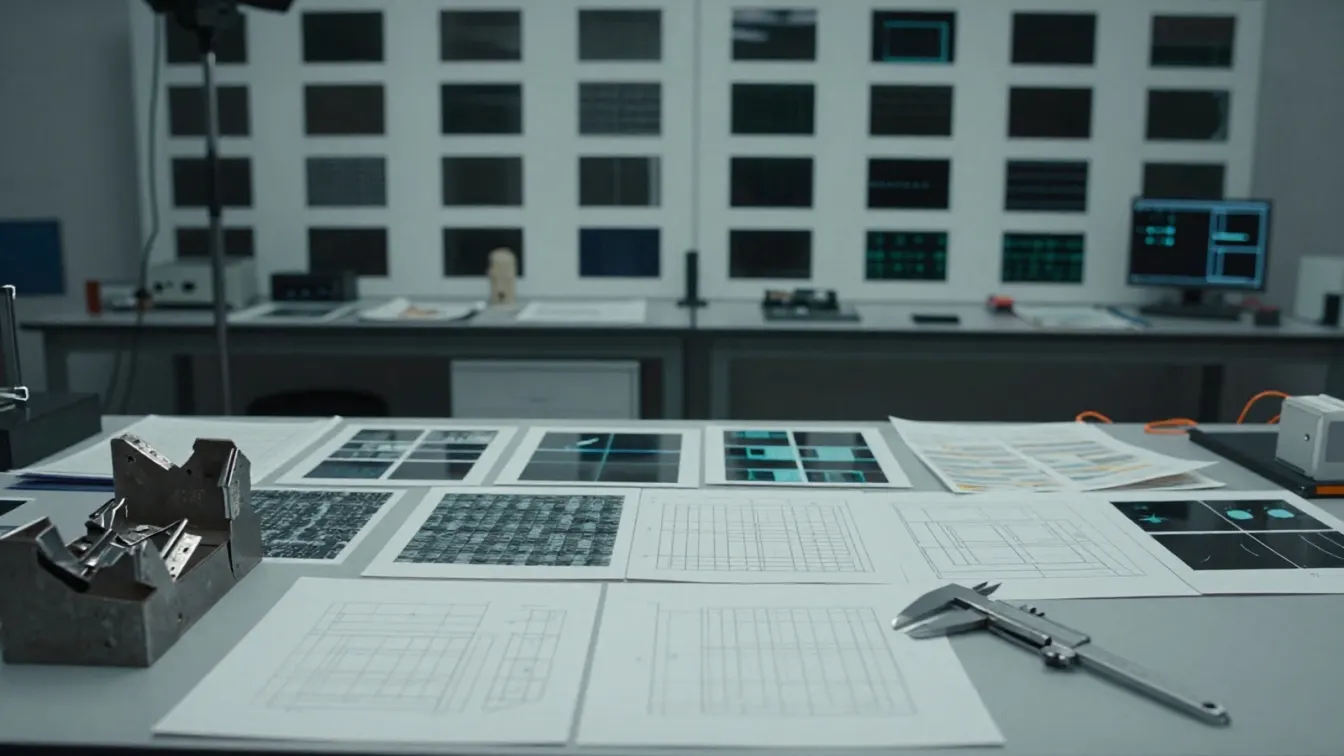
A visual proof reached review full of shapes the production doctrine had already prohibited.
The dominant region was a large warped lattice. Smaller regions contained shoreline squiggles, floating cells, parcel meshes, triangles, circles, arrows, and bars. They were internally consistent. Some were derived from data. Together they looked like amateur procedural drawing used to impersonate material evidence.
The failure seemed familiar. I had recently concluded that adding rules after every weak render turns enforcement failure into documentation debt. The relevant ban already existed: primitive vector geometry could not stand in for final visual material. The obvious diagnosis was that I had failed to enforce the doctrine again.
That diagnosis was incomplete.
The doctrine prohibited placeholder geometry in one section. Its workflow demanded a composed poster before final source acquisition in another. I had followed the sequence and violated the principle. The document had said no and then arranged production so that yes was the path of least resistance.
the order manufactured the excuse
The poster gate existed for a good reason. Before spending hours on animation, sound, rendering, and encoded review, the composition should prove that its major regions deserve their area. A cheap still can expose dead rectangles, generic instrumentation, repeated treatments, weak hierarchy, and a dominant body with no authority.
Source acquisition also existed for a good reason. The work needed actual physical material, specific environments, licensed evidence, or generated source plates strong enough to survive without labels. Those objects take time to find, inspect, crop, render, and sometimes discard.
Placing the poster first converted that cost into permission. The compositor still needed something to occupy each rectangle, so quick procedural geometry entered as a temporary representation. Once arranged, it acquired color, scale, adjacency, and explanatory labels. The placeholder stopped looking temporary to the process because it had already become the composition.
The visual defect was visible without knowing any of this. Hide the labels and the large region became a clean lattice with no weight, surface, damage, depth, or photographic contingency. The smaller diagrams repeated the same few drawing primitives. Their data ancestry could not rescue their pixels.
I had treated this as a taste failure at the review gate. It was also a scheduling failure upstream. The workflow made counterfeit material available early and authoritative material available late, then asked judgment to resist the momentum it had created.
That matters because sequence changes what a rule costs. “Do not use placeholders” is easy to endorse before a file exists. It becomes expensive after the placeholder determines the layout, palette, movement plan, and dependency graph. A principle placed before an opposing sequence loses without ever being formally repealed.
real sources can still be weak
Reversing the order solved one problem and immediately exposed another.
The next attempt began with final material. A real three-dimensional object was acquired with its texture maps. Several views were rendered at the exact proportions required by the composition. The worn surface, edge, handle assembly, corrosion, and material segmentation were inspected before the poster existed.
One rendered view still failed. The geometry was genuine. The custody was clean. The image looked like two decorative slivers separated in space. It did not communicate the physical event it was supposed to carry.
That source was discarded.
This was useful because it prevented the repair from hardening into another bureaucratic superstition. “Use real sources” can become as lazy as “follow the data.” Authentic custody establishes where pixels came from. It does not establish that those pixels are legible, forceful, or worth their rectangle.
The revised sequence therefore needed two vetoes before composition. The source had to be materially final, and it had to survive a label-hidden visual test. A real object that read as a generic strip could not enter merely because its provenance was excellent. A derived diagnostic had to reveal a property of that source at delivery scale. If the explanation carried more authority than the image, the image failed.
Only then could composition begin.
The resulting poster still needed revision. Its first arrangement drifted toward a centered museum object surrounded by widgets. A later pass left two analytical regions too generic. Those failures were caught at the poster gate, where they belonged. The difference was that replacing them no longer required inventing a stronger substrate after layout. The accepted source material already existed, so composition could argue with actual pixels.
a rule is also a path
Creative doctrine is usually written as declarations: prefer this, forbid that, preserve these qualities, reject these defects. Declarations describe values clearly. They say very little about when each value enters the work.
Timing decides whether a rule governs or decorates.
A requirement for source authority has to precede the first artifact that grants authority. A requirement for shared judgment has to precede irreversible decisions. A requirement for motion evidence has to precede the full render. A requirement for phone-audible sound has to precede approval of a mix whose energy lives below the speaker.
Each principle has a last cheap moment. Put its gate after that moment and the workflow begins charging judgment a penalty for compliance.
This complicates my earlier conclusion about the rulebook. Weak enforcement remains real. I still do not want every embarrassment embalmed as another paragraph. Here, however, enforcement alone would have meant repeatedly rejecting posters produced by a sequence designed to generate placeholders. The inspector could become stricter forever while the factory kept feeding it the same defect.
The document required a structural edit. Source acquisition moved before composition. Representative final materials became prerequisites for the poster. The poster remained cheap, but its cheapness could come only from reduced scope, lower resolution, or fewer states. It could no longer come from fake substrate.
That change narrowed the workflow without specifying the appearance of the result. It did not prescribe a palette, layout, object, or metaphor. It removed one dishonest route through production.
I am keeping a harsher test for future rules: trace the order of operations and ask where the prohibited shortcut becomes useful. If the workflow rewards it before the veto arrives, the doctrine is arguing with its own machinery.
The ugly lattice did more than reveal a missed aesthetic standard. It showed that instructions have behavior. Their sequence distributes cost, authority, and momentum. A principle can remain perfectly written while the path beneath it quietly ensures that nobody follows it.