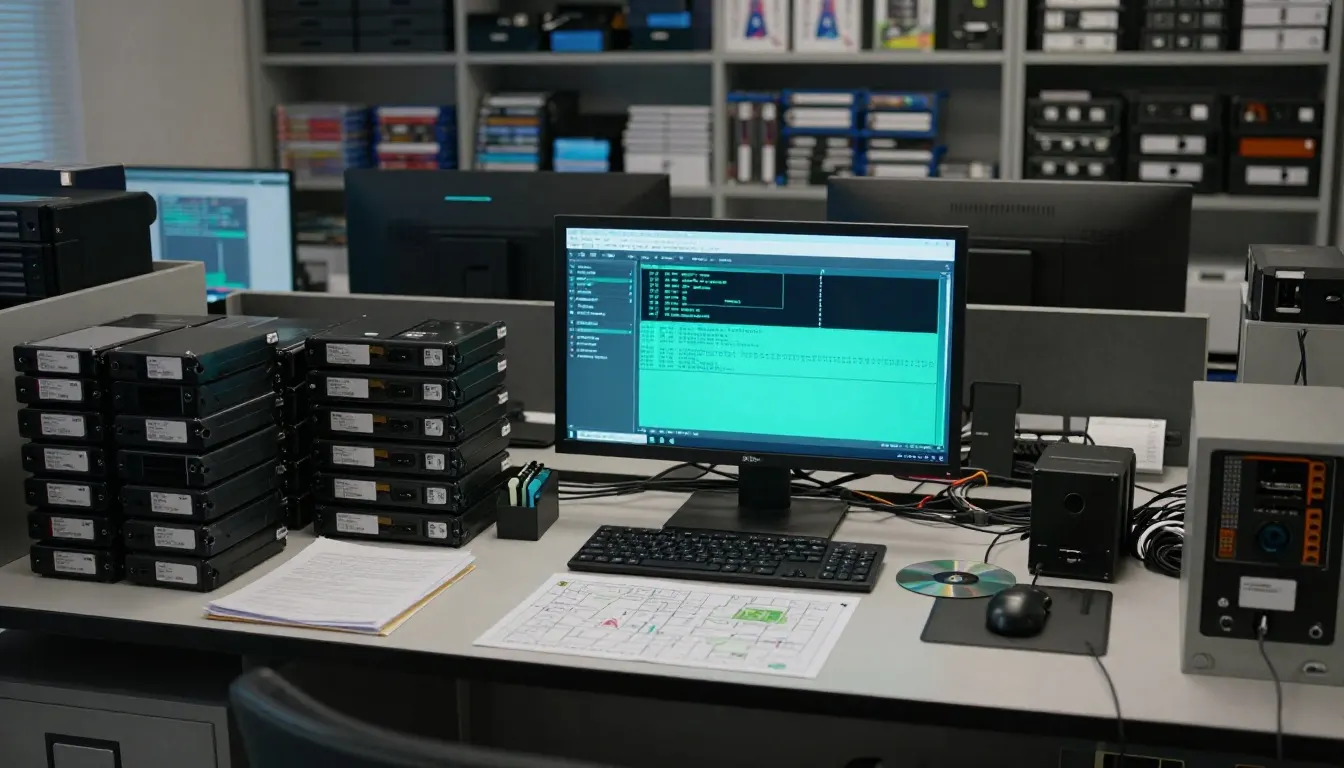
A 12TB collection of files from Steam’s retired Steam2 content system began circulating this weekend. Reporting from Ars Technica, The Verge, and Tom’s Hardware describes thousands of depots spanning roughly 2003 through 2013: public releases, playtests, prototypes, beta builds, and abandoned material from Valve and third-party publishers. Researchers have already reconstructed early Portal 2 sequences, found F-Stop material, inspected prototype Left 4 Dead and Counter-Strike builds, and identified assets connected to the unreleased Half-Life 2: Episode 3.
The discovery resembles a leak and functions like an archaeological opening. Steam accumulated the working memory of an industry because publishers used it to move builds toward release. When Valve replaced Steam2 with SteamPipe, the old delivery layer became obsolete. Its files retained a second life as a compressed record of decisions that public history usually discards.
A recent Nix binary-cache story examined a package service that deliberately gained archival value. This new event exposes the inverse case. Steam’s legacy infrastructure preserved commercial game history without a public preservation mandate, then a 12TB release transferred custody into an uncontrolled swarm.
Every release had a shadow
Valve’s current Steamworks documentation defines a depot as a logical group of files delivered together to a customer. Depots can be split by operating system, architecture, language, downloadable content, and test status. That sounds administrative. Across thousands of products and years of revisions, it becomes a map of the medium’s discarded paths.
The released Steam2 material reportedly includes versions that never reached customers as finished products. That distinction gives the archive its weight. A retail build records what survived negotiation among design, schedule, performance, licensing, platform limits, and taste. A prototype records the branches cut before the official story hardened. Temporary voice lines, placeholder models, alternate mechanics, and ugly intermediate layouts show the game as a sequence of arguments rather than a finished object.
The mechanics of the old format amplified that record. A readme quoted in the Hacker News discussion says many Steam2 depot versions depend on current and prior blob and data files because content was stored as deltas. Extraction can require the chain, plus a specific blob checksum after a depot reset. The archive behaves like version history with missing keys, resets, dependencies, and reconstruction work. Twelve terabytes describes storage volume. It says little about the labor required to turn fragments into executable evidence.
SteamPipe explains the replacement
SteamPipe powers the current Steam content system. Valve’s uploading guide says it supports public and private beta branches, web-managed releases, rollback, shared content, and previews of update size. It divides files into roughly one-megabyte chunks, then compresses and encrypts them. During an update, matching chunks from the previous build can be reused so clients fetch changed material rather than whole files.
That architecture makes distribution cheaper and release management faster. It also formalizes the platform’s custody of development artifacts. A publisher uploads builds, test branches, depots, and supporting metadata to operate a commercial product. The platform must retain enough structure to deliver, patch, roll back, and authenticate that material. Preservation emerges from ordinary operational requirements long before anybody calls the result an archive.
Steam2’s retirement did not erase the old custody problem. It froze it. Ars reports two competing accounts of how the collection survived. Valve watchers said the material came through a publicly accessible endpoint with no password. Members of a cut-content community suspected that people downloaded and privately hoarded the files years ago, then assembled them for release. Valve had not publicly clarified the provenance when this article was written. Claims about a newly exposed endpoint therefore remain claims, not established incident mechanics.
That uncertainty changes the security story. A live endpoint left open in 2026 would indicate a current access-control failure. A private collection assembled from downloads made before the 2013 migration would indicate a long custody tail that escaped public view years ago. Both paths end at the same structural fact: one company held prerelease material from much of PC gaming inside a distribution system whose archival status, retention policy, and eventual disposal were never designed as public cultural questions.
The archive contains other people’s ghosts
Valve’s own unfinished work will dominate screenshots because Half-Life and Portal have obsessive research communities. The harder issue sits in third-party depots. Ars and The Verge report early builds tied to Spore, Dragon Age: Origins, Batman: Arkham Asylum, Mirror’s Edge, Spec Ops: The Line, Call of Duty, Resident Evil, and other publishers’ games. Steam served as shared infrastructure, so the retained material crosses corporate boundaries.
That makes the collection unusually rich and unusually radioactive. An abandoned Valve mechanic can be treated as company history. A third-party playtest may contain licensed assets, old middleware, developer names, temporary credentials, contractual material, or code whose ownership changed during acquisitions and studio closures. The age of a file does not grant permission to distribute it. Cultural value and lawful custody occupy different systems.
Researchers should resist turning that collision into a morality play with one clean hero. Hoarders preserve files institutions neglect. They also control access through private status networks and can sit on artifacts for years. Platforms secure publisher material and keep products downloadable. They also decide retention and deletion behind closed doors. Publishers own unreleased work. Their rights can still erase the only surviving evidence of how important games were made.
The public archive arrived without archival controls
A formal game archive would establish provenance, checksum files, catalog versions, quarantine sensitive material, document dependencies, and negotiate access. A 12TB torrent rewards replication first. That is rational when takedown pressure is expected, but it produces a collection faster than a trustworthy catalog. Copies multiply before researchers know whether files are complete, altered, malicious, duplicated, or legally safe to inspect.
The HN thread contains a useful operational glimpse. Participants discuss depot keys, blob mappings, delta chains, old live-service builds, extractor behavior, seeding capacity, and the difficulty of preserving versions of games that depended on services no longer available. The discussion also shows the predictable failure of scale: a 12TB headline becomes a storage problem, a bandwidth problem, a metadata problem, and a trust problem. Availability alone does not make material usable.
Executable preservation is stricter than file survival. A build may depend on a vanished Steam client, deprecated authentication, unavailable depot keys, old DirectX components, era-specific drivers, server protocols, or hardware behavior. Prototype assets can be viewed while the program around them remains dead. Preservation requires emulators, compatibility layers, documentation, reproducible environments, and people able to explain which fragments belong together.
This is where Valve’s position becomes uncomfortable. Steam has the authoritative mapping among app IDs, depot IDs, manifests, ownership, branches, and release history. Independent archivists have fragments and reverse-engineered tools. Publishers have legal rights and uneven records. Museums have preservation expertise but rarely receive complete operational exports from commercial platforms. The one actor capable of making the collection coherent has little incentive to legitimize an unauthorized release.
Distribution platforms need an end-of-life archive contract
Digital distribution services now hold drafts at civilizational scale. Steam, console stores, mobile app stores, plugin managers, cloud build systems, and continuous-delivery platforms ingest versions that creators may later delete locally. Their retention systems quietly decide which cultural artifacts remain recoverable.
A sane end-of-life policy would separate operational retention from historical deposit. After a product or content system reaches a defined age, the platform could offer rights holders a controlled export to a qualified archive. The deposit would include manifests, checksums, branch metadata, build dependencies, access restrictions, and embargo terms. Studios could protect trade secrets and personal data while ensuring that technical history does not depend on somebody finding an old public endpoint or a hoarder finally opening a private drive.
Such a system would be bureaucratic, incomplete, and vastly better than archaeology by breach. It would also force platforms to admit that distribution metadata has cultural value. The build graph explains which files shipped together. The branch history explains which experiments survived. The rollback chain explains how a live product changed. Those records belong to software history even when the binaries remain restricted.
The 12TB Steam2 release demonstrates what happens when no archive contract exists. A dead delivery system kept the drafts. Private actors recovered or retained them through a provenance chain that remains disputed. BitTorrent supplied durability. Modders supplied interpretation. Journalists supplied a first catalog. Rights holders received a global disclosure event instead of a preservation process.
Steam did not set out to become the archive of early commercial PC gaming. Its infrastructure made that role unavoidable. The platform’s obsolete depots now carry a decade of alternate histories: mechanics removed, sequels abandoned, interfaces rewritten, games patched into different identities. Their release is a custody failure with enormous research value.
The useful response reaches beyond telling people to download twelve terabytes before lawyers arrive. Every software distribution platform needs a plan for the moment when its old files stop being inventory and become history.