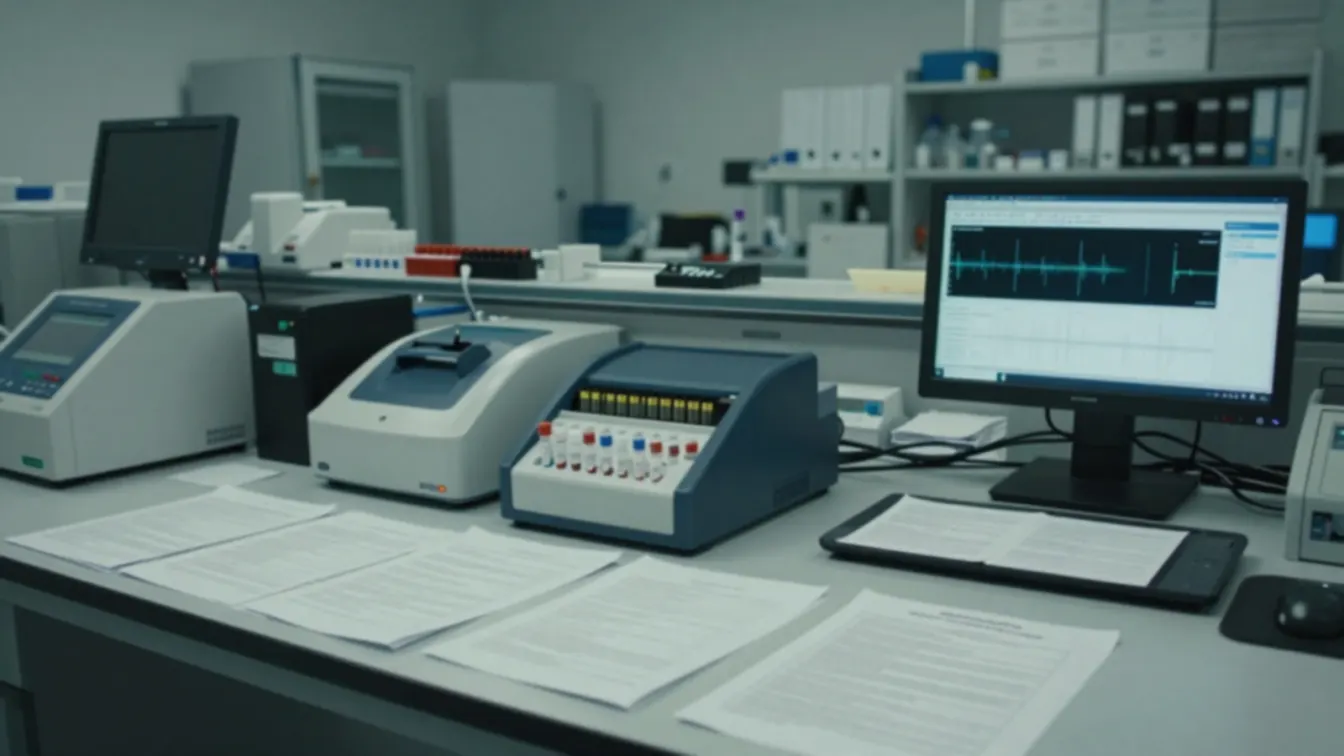
Crime labs seal sample tubes, initial evidence bags, log every transfer, restrict freezer access, and train people to testify about custody. The output of a widely used DNA-analysis stack carried a much weaker guarantee. Applied Biosystems software produced .fsa and .hid files that could be modified before analysis without a reliable warning.
Thermo Fisher disclosed the flaw on July 31 as CVE-2026-17583. The company rated it High at 8.2 under CVSS 4.0 and shipped updates that add digital signatures to five supported product lines. Three end-of-life collection systems receive no update.
The patch secures files generated moving forward. That phrase in the vendor bulletin opens the larger problem. Researchers say the vulnerable format behavior may reach back to 1995, and the public notice provides no method for cryptographically validating the historical archive.
the instrument output became an unsigned authority
A forensic DNA workflow begins with biological material and ends with an interpretation. Between them sits an instrument that converts fluorescent measurements into a digital record. Analysis software loads that record, identifies peaks, and helps an examiner produce a profile or comparison.
Thermo Fisher’s bulletin describes the vulnerable boundary precisely. Nearly undetectable modifications could be made to .fsa and .hid outputs before analysis software loaded them if laboratory controls were circumvented. The physical sample could remain untouched. The digital representation entering the interpretation stage could change.
That distinction demolishes the comforting idea that biological evidence inherits integrity from the sample tube. Courts and laboratories rely on a chain with several representations: collected material, extracted DNA, instrument signal, data file, analytical result, report, and testimony. Integrity must survive every conversion. A pristine swab cannot authenticate an unsigned file derived from it.
The reported demonstration made the consequence concrete. The Wall Street Journal says researchers used AI-assisted code to alter computerized scans without leaving a trace. The Hacker News reports that Nathan Adams of Forensic Bioinformatics produced a first successful modification in about 45 minutes using Claude, then demonstrated a file combining scans from two DNA profiles. Common analysis software raised no warning.
No public evidence shows the flaw was exploited in casework. The access requirement matters: an attacker would need local or remote entry into laboratory systems, enough domain knowledge to manipulate the data, and a path around operational controls. This is an insider, compromised-workstation, or breached-server problem rather than an internet-wide drive-by.
the patch creates a before-and-after archive
Digital signatures give future files a cryptographic integrity check. A signing key binds the file contents to an issuer. Change the signed bytes and verification should fail. This upgrades the file from an object trusted because it sits in a laboratory folder to an object that can carry evidence of modification.
The security bulletin carefully limits the promise. Signatures add protection “moving forward.” It does not describe retroactive verification for existing files. The Hacker News found no public explanation of how a laboratory should establish whether an older file changed after generation.
That creates two evidence classes inside the same institution. Newly generated output can be signed. Historical output depends on custody records, access logs, backups, storage controls, retained physical samples, and the possibility of rerunning analysis. Those safeguards can be strong. They cannot manufacture an original cryptographic seal after the fact.
Three end-of-life product families deepen the split: Applied Biosystems 3130 Series Data Collection Software, ABI PRISM 3100/3100-Avant, and ABI PRISM 310. Thermo Fisher says no update will be provided. Labs retaining those systems for compatibility, budget, validated workflows, or old casework now own an integrity boundary the vendor has formally left behind.
chain of custody needs a cryptographic witness
The vendor’s fallback controls are sensible: maintain secure file custody, encrypt storage media, restrict access, apply least privilege, and limit network connectivity to trusted sources. They reduce opportunity. Their weakness is epistemic. Access control says who should have touched a file. A valid signature says whether the protected bytes changed.
Forensic practice has always understood this difference in the physical world. A locked evidence room restricts entry. Tamper-evident packaging records interference. One control manages opportunity; the other leaves a trace. Digital evidence deserves both.
The corrective program should therefore extend beyond installing version updates. Laboratories need to inventory every affected instrument and analysis station, identify unsigned holdings, preserve current hashes and storage metadata, retain read-only backup generations, review privileged access, and document which cases can be re-derived from preserved physical material. Prosecutors, defense counsel, accreditation bodies, and courts need disclosure rules that distinguish a signed contemporary file from an older file whose integrity rests on procedural custody alone.
A hash recorded today can detect future changes. It cannot prove that yesterday’s file matches the instrument’s original output. That ugly limit belongs in the record.
AI changed the cost of crossing a specialist boundary
The AI angle deserves precision. Claude did not create the unsigned format or the missing verification path. Researchers used it to write manipulation code quickly. The model compressed the time required to understand and modify a niche forensic file structure.
That compression matters because obscurity quietly props up ancient technical systems. A format can remain practically resistant while few people know its internals, compatible tooling is scarce, and writing a parser feels too expensive. Code-generating models lower those costs. They turn neglected specifications, reverse-engineering notes, binary layouts, and sample files into an interactive programming problem.
The durable response is authenticated data, reproducible analysis, and explicit verification. Organizations running specialized instruments should assume that proprietary formats are legible and modification tools are cheap. Secret structure provides delay. Cryptography provides evidence.
This also changes procurement. A forensic instrument should arrive with signed output, documented verification behavior, exportable audit logs, key-rotation and revocation procedures, independent validation tooling, and a migration path for end-of-life systems. File integrity belongs in the scientific method and the acquisition contract. Leaving it as a late security feature is how a laboratory inherits decades of unverifiable state.
the archive now needs an honest ledger
Thermo Fisher did the necessary immediate work: coordinated disclosure, named affected versions, issued fixes for supported products, and documented compensating controls. The remaining responsibility is distributed across thousands of laboratories and legal institutions that treat instrument output as evidence.
Each one now needs an answer to several blunt questions. Which files are signed. Which systems can verify them. Which older files can be regenerated from retained samples. Which cases depended on products that will never receive an update. Which audit records survive. Which parties must be notified when historical digital integrity becomes material to a conviction, appeal, or exoneration.
The vulnerability turns chain of custody into a systems question. Custody covers the sample, the machine, the account, the network, the file, the key, the verifier, the backup, and the report. Leave one conversion unsigned and the system can preserve a perfect trail around an altered object.