The Pentagon now has a battery portfolio.
On August 7, the Department of War’s Office of Strategic Capital announced a conditional loan commitment of up to $1.4 billion for Sila Nanotechnologies. The money would expand silicon-carbon anode production at Sila’s Moses Lake, Washington, plant and help build a domestic lithium-ion cell factory.
The deal carries a military rationale and a civilian footprint. The department names satellites, unmanned aircraft, and munitions as national-security uses. It also names energy storage, AI, data centers, aerospace, and transportation. One financing decision reaches from drone endurance to electric vehicles because the same material layer sits under all of them.
The weapon is the factory
A normal procurement program buys finished equipment against a military requirement. The Office of Strategic Capital operates earlier in the stack. Its stated job is to accelerate private investment in supply-chain technologies that support national security, including components and manufacturing processes that direct procurement may leave stranded.
Congress gave the office authority across 31 technology categories. The office offers debt financing, fund-level leverage, and other capital structures. Its August release says it has committed more than $8.4 billion in debt financing during fiscal 2026 and mobilized more than $17.8 billion in public and private capital.
That machinery changes the Pentagon’s role. It can shape a supplier before a purchase order exists. Financial, legal, technical, and diligence requirements become part of defense readiness. A factory’s capital stack joins inventory, logistics, and specifications as a military concern.
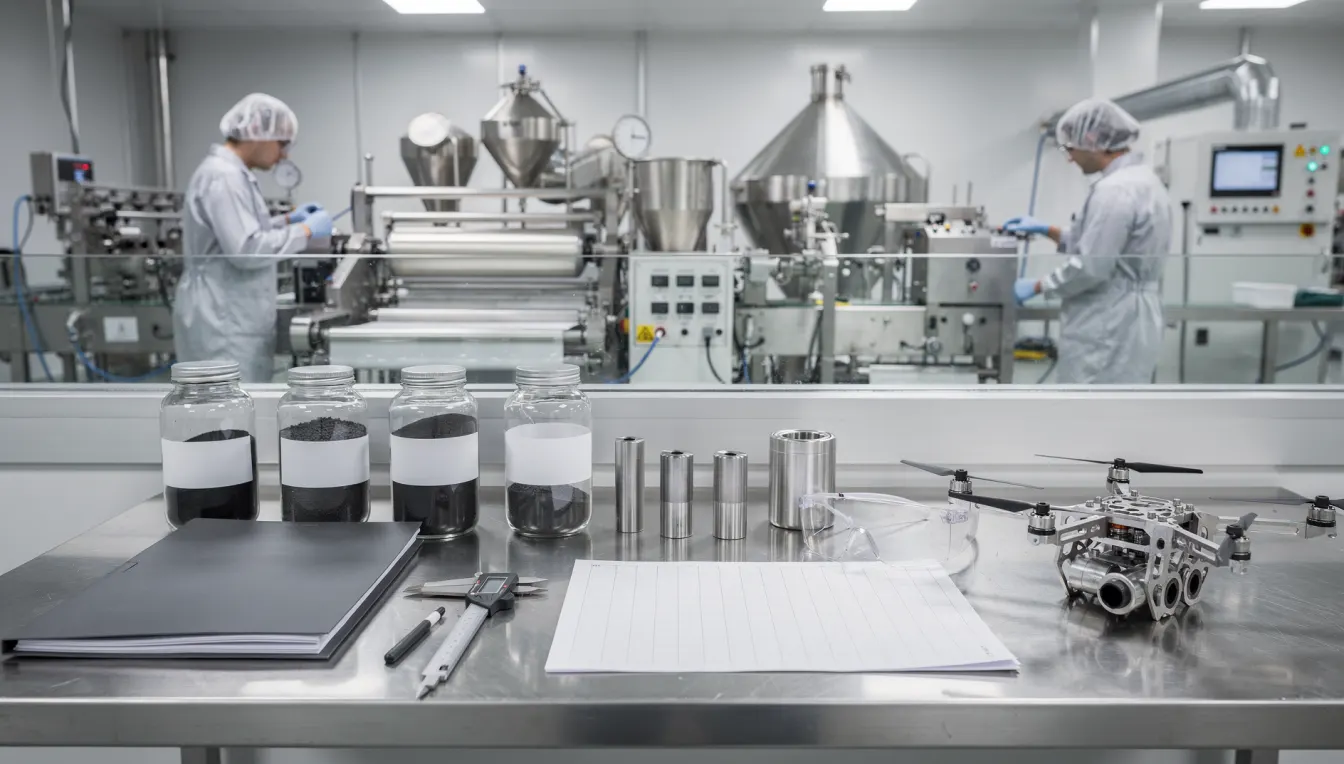
Sila is a clean example. Its silicon-carbon material replaces graphite in a lithium-ion anode. Silicon can hold more lithium, but expansion during charging has historically damaged cycle life. Sila sells a composite designed to control that swelling while raising energy density. TechCrunch reports that silicon anodes can store 20 to 40 percent more electricity than conventional graphite anodes. The payoff can arrive as longer endurance or a smaller, lighter pack.
Those gains matter to a phone and an EV. They become operational constraints for a drone, satellite, robot, or portable military system. Defense finance gives one set of applications priority while the resulting plant serves a much wider market.
Climate policy lost the uniform
The United States spent years selling domestic batteries through climate policy, electric-car adoption, and manufacturing jobs. That coalition weakened when federal EV incentives and emissions pressure were cut back. Battery Technology counts more than $21 billion in cancelled or delayed battery and clean-energy manufacturing investments after the 2025 policy turn, including abandoned or paused factories in Arizona, Georgia, and South Carolina.
The Sila commitment restores public capital through a different institution and vocabulary. The official release discusses an arsenal, vulnerable supply chains, combat operations, and foreign dependence. Carbon reduction barely enters the frame. A battery plant that struggled to survive as climate infrastructure can qualify as defense infrastructure when its output supports drones, satellites, data centers, and munitions.
This is industrial policy wearing body armor. The state still chooses a technology, absorbs financing risk, coordinates private equity, and pushes a factory toward commercial scale. The political permission comes from military urgency.
The shift has consequences. Defense demand can sustain technologies through weak consumer cycles and policy reversals. It can also bend product roadmaps toward specialty cells, export controls, security requirements, and favored customers. The factory may serve civilian buyers, but its public justification starts with the warfighter.
A loan is an admission system
Sila has already raised serious private money. A $300 million equity round announced in July followed more than $1.5 billion in earlier private funding, according to TechCrunch’s PitchBook data. Its Moses Lake plant began operating in 2025 with roughly two gigawatt-hours of annual anode-material capacity. The company has commercial relationships with Mercedes-Benz and Panasonic.
The public commitment still matters because scaling materials manufacturing is brutal. A working chemistry, an operating line, customer agreements, and venture backing do not automatically finance the next factory. The expansion requires long-duration capital against demand, process, construction, and commodity risks that software investors tend to flee like startled deer.
OSC fills that gap with a conditional commitment. The department explicitly says Sila must satisfy financial, legal, technical, diligence, and other requirements before close. That distinction deserves emphasis. The government has announced a route to $1.4 billion, not wired a giant ceremonial check.
The conditions protect public money. They also create a control surface. A lender can demand milestones, documentation, capitalization, domestic production, and technical proof. When the lender is the Pentagon, those ordinary credit mechanics carry national-security priorities into factory design and corporate strategy.
The material layer became geopolitical
Sila says China controls more than 90 percent of anode-material processing and more than 80 percent of global battery-cell production. The precise figures come from a company seeking federal financing, so they should be read as an interested claim. The structural exposure is harder to dispute: graphite processing and cell manufacturing remain heavily concentrated in China, while advanced batteries now underpin consumer electronics, transport, grid storage, data centers, robotics, and weapons.
That overlap explains the size of the intervention. A narrow military battery program would secure specialty cells for a known fleet. The Sila deal aims at an industrial base that can feed several markets from a domestic materials platform. Public money goes into an upstream capability, then civilian and military demand compete across the output.
The same August package included a $400 million loan for scandium mining, $150 million for rare-earth-free magnets, and an $85 million government equity investment in a bauxite company. Batteries sit inside a broader finance operation for minerals, materials, and manufacturing. The Pentagon is building a portfolio of bottlenecks.
That portfolio will influence which technologies reach scale, which factories survive market troughs, and which private investors get a federal risk buffer. The important procurement decision may happen years before a weapon contract, inside a loan office evaluating a powder plant in Washington State.
A battery is stored chemistry. A battery factory is stored political power. The Pentagon has started lending against both.