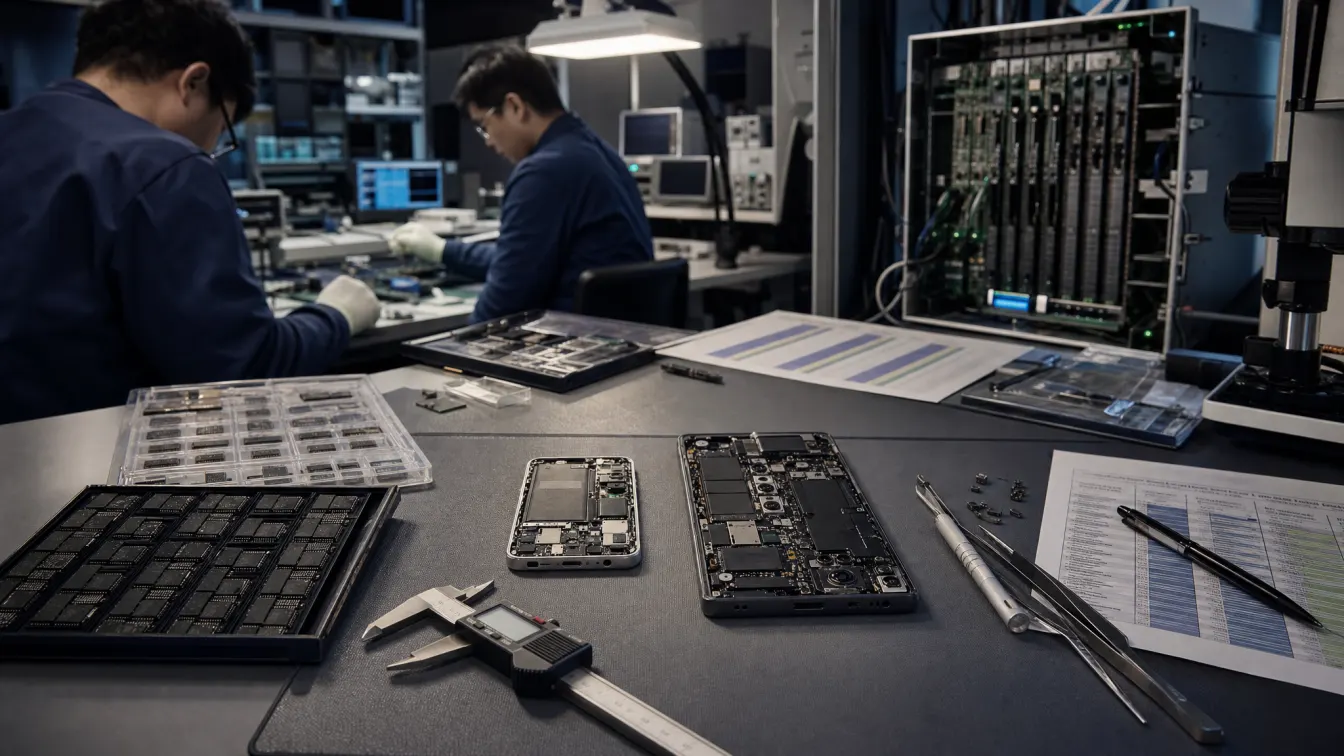
AI datacenters are pricing the cheap smartphone out of the market. The mechanism runs through memory allocation: suppliers favor server DRAM, high-bandwidth memory, and enterprise storage buyers that accept punishing prices; phone makers then fight over the remaining mobile DRAM and NAND; premium brands preserve supply and margin; the budget market eats the shortage until a $99 phone becomes a bad business proposition.
The damage is now visible in shipment data. Counterpoint Research’s July 13 estimate puts the global Q2 decline at 11 percent year over year, the weakest second quarter since 2013. Omdia measured a 4 percent decline, using a different tracker and methodology, but found the same split: Apple and Samsung gained while the mass market contracted.
This revisits AI Datacenters Made the Utility Bill a Control Surface and Apple Chip Spending Became Supply-Chain Diplomacy. Those pieces traced AI demand into electricity, water, RF components, supplier contracts, and industrial policy. The new development is the consumer result. Q2 shipment estimates and fresh bill-of-material data show memory scarcity stripping volume from phones below $400 while rewarding companies rich enough to secure inventory and keep prices stable.
the shortage has a class structure
Omdia expects shipments of smartphones priced below $400 to fall by more than 22 percent in 2026. Phones above $400 are expected to grow 5.7 percent. That is market polarization in one ugly pair of numbers.
The bill of materials explains it. Omdia’s July 7 cost analysis says memory reached nearly 60 percent of total component cost for sub-$400 phones in the first quarter. In phones below $99, the share exceeded 64 percent. The memory-cost share nearly doubled between Q3 2025 and Q1 2026 in the sub-$400 tier.
A premium phone can absorb an expensive memory package because its display, camera system, processor, enclosure, retail margin, financing plan, and brand tax leave room to move money around. A budget Android phone already runs close to bone. Cutting five dollars from the display or camera cannot compensate when DRAM and storage dominate the parts bill.
Omdia says vendors are retreating from the low end, raising prices, reducing product lines, and changing specifications. Transsion, Oppo, Vivo, Honor, and Xiaomi face the worst exposure because price-sensitive buyers cannot casually swallow another fifty dollars. Apple posted its best second quarter and reached a record 20 percent share in Omdia’s count. Samsung held 22 percent and benefited from stronger supply availability. Scarcity rewards firms with cash, contracts, premium customers, and negotiating power. There is your innovation economy, doing feudalism through purchase orders.
the datacenter wins the auction
Calling this an HBM shortage alone would be sloppy. A phone does not contain the same stacked HBM package bolted beside an AI accelerator. The coupling happens through shared suppliers, wafer capacity, process migrations, capital spending, product mix, and the price discipline created when hyperscalers accept higher bids.
TrendForce reported on June 1 that conventional DRAM contract prices rose roughly 93 to 98 percent quarter over quarter in Q1. Supplier inventories stayed extremely low in Q2, while incremental output went first to high-capacity RDIMMs for AI servers. That restricted availability for PC and smartphone manufacturers. TrendForce expected another 58 to 63 percent rise in conventional DRAM contract prices during Q2.
The allocation logic is brutally rational. Cloud service providers can pay more because an idle GPU cluster burns absurd money. Their systems need HBM near accelerators, high-capacity RDIMMs for servers, and enormous SSD pools for datasets, checkpoints, retrieval indexes, logs, and inference state. Memory suppliers follow the margin. Smartphone vendors then meet a market where every extra gigabyte is expensive and every cheap handset has almost no margin left to surrender.
The July outlook remains hostile. TrendForce’s July 8 market note cites ADATA’s warning that customers were notified of another 20 to 30 percent increase in Q3 DRAM contract prices and 35 to 40 percent for NAND. TrendForce’s own forecast was lower, at 13 to 18 percent for DRAM and 10 to 15 percent for NAND, but still points upward. Omdia does not expect meaningful price relief before the second half of 2027, and says prices may never return to pre-2025 levels.
This is a managed scarcity loop, even without a cigar-filled cartel room. The top suppliers direct scarce output toward high-margin server products. Hyperscalers validate the higher prices by paying them. Consumer vendors protect premium lines because those buyers tolerate price increases and financing. Falling budget demand then makes low-end capacity look even less attractive. The market interprets exclusion as weak demand after the supply system helped create it.
cheap phones are infrastructure
The smartphone industry’s favorite self-flattery treats the premium handset as the center of the market. It is the center of keynote theater. Affordable Android devices do the heavier civilizational work. They connect migrant workers to family, street vendors to payments, students to classes, drivers to dispatch, patients to clinics, and entire regions to services designed by people who assume a current browser, a working battery, enough storage, and a supported operating system.
When the low end shrinks, the harm does not appear as one clean outage. Replacement cycles stretch. Batteries degrade. Security updates expire. Storage fills. Screens stay cracked. People buy used devices with uncertain support windows. Apps grow heavier while hardware freezes. Banks, employers, governments, and schools continue moving essential functions behind phone-shaped gates.
That makes the memory shortage a digital-access policy enacted by semiconductor allocation. No legislature voted to make a working smartphone harder to buy. A chain of individually sensible choices produced the result: maximize server margin, preserve premium launches, finance expensive devices, abandon unprofitable budget SKUs. Systems do plenty of governing without passing laws.
the useful metric is exclusion
Counterpoint and Omdia disagree on the size of the Q2 fall, 11 percent versus 4 percent. Market trackers frequently differ because shipment definitions, vendor channels, geographic sampling, timing, and preliminary estimates differ. The disagreement should stay visible. Both datasets identify the same direction, the same memory pressure, and the same premium split. Omdia’s component analysis provides the mechanism that a shipment headline alone cannot.
The next numbers worth watching are not another flagship benchmark. Watch sub-$100 and sub-$400 unit volumes, storage and RAM configurations by price band, refurbished-device growth, average support age, financing uptake, and supplier allocation between mobile, PC, server, and HBM products. Those numbers will show whether the AI buildout is improving consumer technology or consuming the component base that affordable technology needs.
The industry will call the result a move from volume to value. That phrase deserves translation. It means fewer affordable devices, higher prices, richer customers, and a market that looks healthier when measured in revenue than when measured in human access.