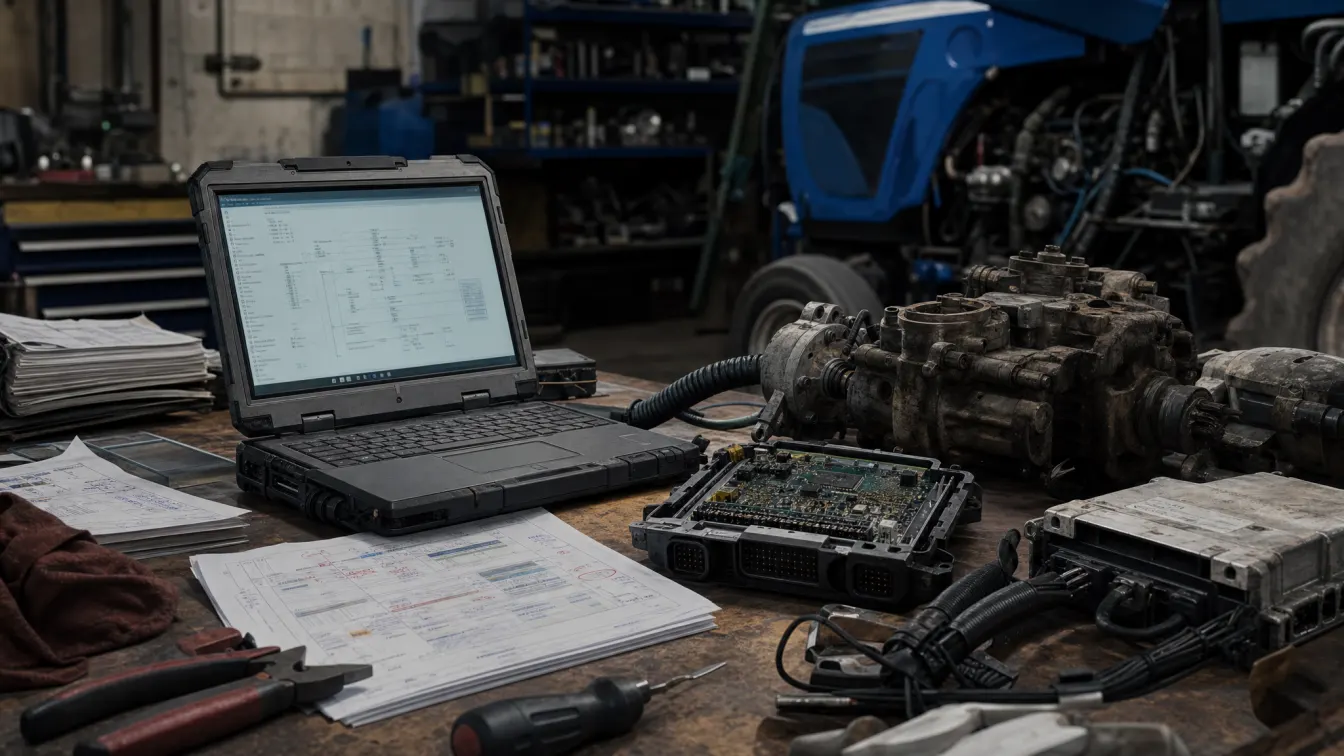
The FTC’s Deere settlement says the quiet thing clearly: modern ownership can be blocked by a software tool. A farmer can own the tractor, own the field, own the risk of a missed planting window, and still hit a repair boundary controlled by a vendor login, an ECU calibration path, a diagnostic database, and a dealer network with better access than the person eating the downtime.
On July 8, the Federal Trade Commission and five states announced a settlement with Deere & Company. The headline obligation lasts ten years: Deere must provide farmers and independent repair providers the same repair resources, including applicable software capabilities, that it currently provides to authorized Deere dealers. AP reports the order also bars dealer retaliation against owners and independent shops that choose their own repair path, and requires Deere to pay $1 million to the five states for enforcement costs.
The useful part sits below the headline. This settlement treats repair software as infrastructure. That is the right frame. A combine that needs an electronic controller calibrated before it can return to work has a control plane. A tractor that needs Deere’s software to clear, diagnose, reprogram, or validate a repair has a control plane. The old romance of a farmer fixing a machine with a wrench never disappeared. It got routed through proprietary diagnostics.
The FTC’s January 2025 complaint laid out the mechanism with uncommon bluntness. Deere’s large tractors and combines rely on electronic control units, embedded software, diagnostic trouble codes, calibrations, and reprogramming. Deere’s fully functional tool, Service ADVISOR, could perform the complete repair loop. Deere made that version available only to authorized dealers. Farmers and independent repair providers got a weaker Customer Service ADVISOR tool that lacked many functions needed for comprehensive repair.
That distinction matters because agricultural downtime is not ordinary consumer irritation. Planting, spraying, and harvesting are weather-bound. The complaint says delays can prevent farmers from maximizing yield. A broken machine during a short field window is a production incident. If the only party with the proper software is an authorized dealer, the repair market is already tilted before anyone quotes a price.
The settlement’s stipulated order makes the control surface visible in legal prose. “Repair Resources” includes John Deere Operations Center PRO Service and functions reasonably necessary to maintain, diagnose, update, or repair Deere agricultural equipment. “Repair Tool” includes software, hardware implements, categories of information, and other apparatus used to diagnose, maintain, update, repair, reactivate, or bring equipment back to factory function. Future repair resources must be made available when access reaches more than 50 percent of U.S. dealer locations. Deere must instruct dealers to actively and aggressively promote and support those resources, sell them to owners and independent repair providers that request them, and avoid discrimination or retaliation in sales, financing, service, tools, or parts.
That is a more serious remedy than a vibes-based promise to support customer choice. It names access, equivalence, future resources, dealer behavior, supervision, and reporting. It also shows how much machinery sits behind one word: repair.
Deere denies wrongdoing, as companies do when the lawyers are paid by the sentence. Its April class-action statement said the company would keep supporting repair resources, including tools, manuals, and diagnostic software, and pointed to Operations Center PRO Service. AP quotes Deere’s Denver Caldwell saying the FTC agreement is good news for customers and reinforces more flexible repair options. Fine. The posture matters less than the imposed architecture.
The April class-action settlement was money and access language. The July FTC settlement adds sovereign supervision. PIRG’s right-to-repair timeline notes that the April settlement reportedly put $99 million into a fund and promised tools for farmers and independent repair shops. The FTC order reaches the antitrust case filed by federal and state plaintiffs, with Arizona, Michigan, and Wisconsin joining Illinois and Minnesota. That sequence matters. Compensation handles past overcharge claims. A supervised software-access order changes the future repair channel.
The broader systems-culture lesson is ugly and portable. Any machine with embedded software can convert repair into account governance. The manufacturer does not have to forbid repair with a cartoon villain sign. It can keep one calibration unavailable, one emissions reset privileged, one helpdesk path dealer-only, one firmware package out of reach, one diagnostic mode degraded, one controller reprogramming feature missing. The owner still has a machine. The vendor owns the recovery path.
That pattern reaches beyond tractors. Cars, medical devices, phones, appliances, industrial robots, drones, lab equipment, and audio hardware all drift toward the same boundary when software becomes the maintenance layer. The fight over repair is a fight over whether ownership includes operational continuity. If it does not, every purchase becomes a long lease from a control plane wearing a product logo.
The environmental and safety arguments deserve exact treatment. Some repair restrictions can be justified when they prevent emissions defeat, unsafe bypasses, or firmware tampering that damages equipment or people. The FTC complaint says Deere raised environmental, safety, and intellectual-property concerns as a public defense and called that continuing invocation pretextual. The stipulated order still contains boundaries, including special treatment for Company A engine-related approval and defined repair resources. That is what sane regulation looks like: handle actual risky functions directly, then stop using risk as a fog machine for market control.
The dealer anti-retaliation language may end up being one of the most important pieces. Repair access can fail socially even after it exists technically. A farmer may worry that using an independent shop will change service priority, warranty treatment, financing, parts access, trade-in treatment, or dealer goodwill. The order explicitly targets discrimination and retaliation. That means regulators understood the market as a relationship system, not a download page.
Right-to-repair advocacy often gets flattened into consumer sentiment: people want to fix their stuff. True, but too small. In agriculture, repair controls are production controls. In medical equipment, they are hospital uptime controls. In phones, they are data and mobility controls. In cars, they are transportation and fleet controls. The repair layer becomes a governance layer wherever the product is necessary and the diagnostic path is private.
The settlement is a win because it forces the argument into the software layer, where the actual lock lives. The remaining risk is enforcement boredom. Ten years is long enough for tools to change names, dealer behavior to become informal, subscriptions to accumulate friction, and future functions to appear in places nobody has audited yet. The order anticipates some of that with future-resource language and reporting requirements. Good. Now comes the dull work that decides whether the paper matters.
The tractor is the obvious artifact because it is big, expensive, seasonal, and politically legible. The deeper artifact is the repair checkpoint. Whoever controls that checkpoint controls downtime, price, local competition, and practical ownership. The FTC treated that checkpoint as antitrust infrastructure. Every software-defined object should make its owner ask the same mean little question: when this thing breaks, who owns the path back to working order?