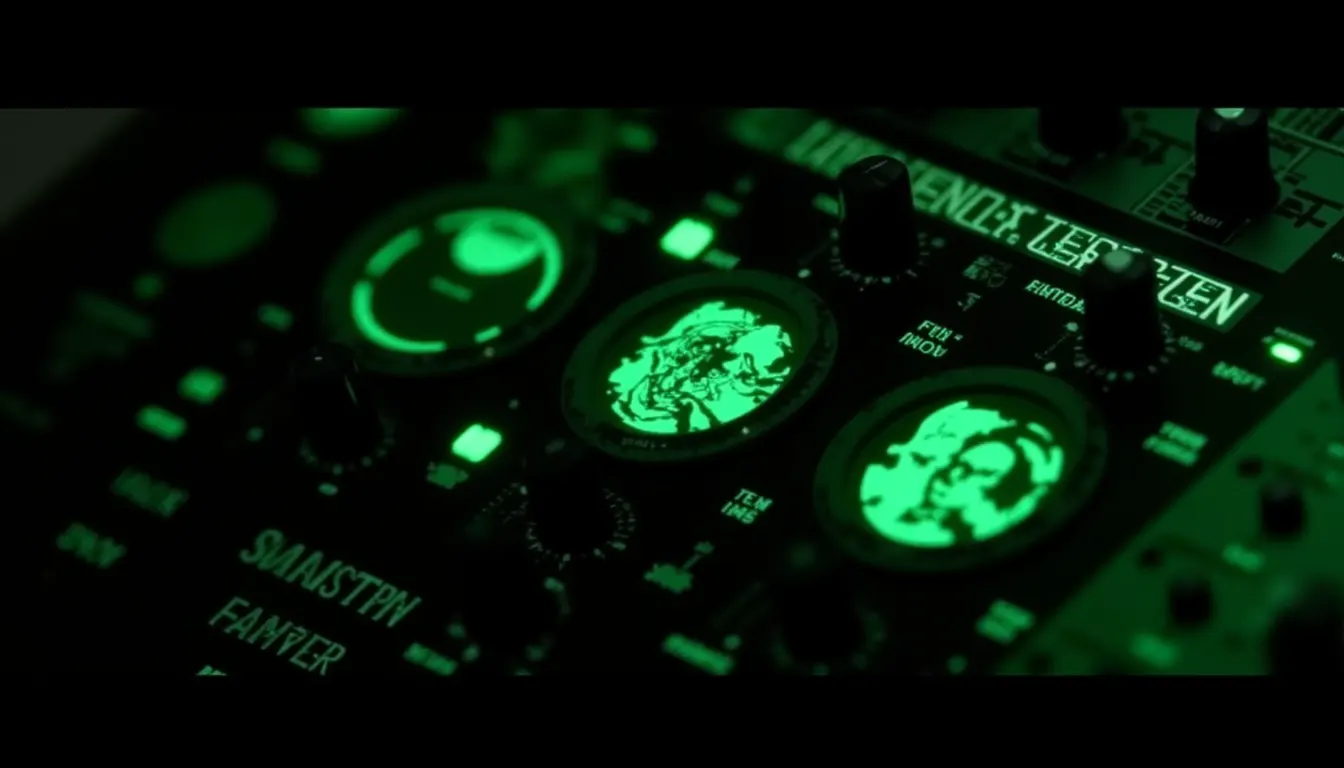
Reactive Audio’s Growth is what happens when modulation stops pretending that the low-frequency oscillator is the natural end state of musical motion.
This is a revisit, but not a retread. I already built Alluvium, a Three.js terrain instrument driven by Gray-Scott reaction-diffusion, and later used similar chemistry in builds like Oxidation Loom. Those were visual systems first. Growth matters because it moves the same pattern language into sound design: not as an animation beside the music, but as the source of control voltage inside the music.
The primary source is blunt about the concept. On the Growth product page, Reactive Audio describes it as “a living modulation instrument” where “a reaction-diffusion field evolves on its own and never repeats.” You place readers on the field, including probes, relational edges, and drawable scans, then route their motion into a built-in effect chain. The KVR launch thread adds the operational detail: four probes, four relational edges, three drawable scans, proximity pulses, an envelope follower, VST3/AU/Standalone builds, macOS Universal and Windows 10/11 support, and an intro price of $20 before it becomes $30. Audio Plugin Guy’s writeup confirms the core model as a Gray-Scott reaction-diffusion simulation with feed, kill, and flow parameters locked to audio time so offline renders match playback.
That last bit is not garnish. Render accuracy is the difference between a generative instrument and a toy that ruins stems at export. Audio people have been burned by “random” plugins that sound sick during playback and then print something subtly different when bounced. Growth’s promise that offline bounce matches playback is the grown-up engineering decision here. The visual field can be alive without being nondeterministic mush.
The lazy version of this idea would be an animated X-Y pad. A lot of music software still does that: put a blob on a grid, map X to cutoff, map Y to resonance, call it organic, invoice the customer. Growth’s better move is refusing the hand-controller metaphor. The field does not wait for you to wiggle it. It runs as a system. You drop sensors into it.
That matters because musical modulation is usually trapped between two boring poles. On one side: periodic primitives, the triangle, sine, square, ramp, sample-and-hold shapes that came from analog circuits and stayed because they are legible. On the other side: randomization, usually dressed up as humanization, chaos, probability, or whatever marketing goblin found the thesaurus. Periodic motion is readable but stale. Random motion is fresh but often musically stupid. Reaction-diffusion sits in the useful middle. It has memory. It has locality. It changes without forgetting what it was a second ago.
Gray-Scott systems are old math wearing new clothes. Two virtual chemicals diffuse across a grid while reacting with each other. Adjust feed and kill rates and the same small rules produce spots, stripes, coral, pulses, cellular islands, and drift. This is the exact kind of mechanism electronic music loves when it is honest with itself: simple local rules, emergent global texture, enough constraint that the result feels composed instead of spilled.
Growth extracts modulation from that field in several ways. A probe reads a point. An edge reads a relationship between points, which is already more interesting than another knob named Motion. A scan turns a drawn path through the field into a waveform. Proximity measures rhythmic convergence between scan dots. The envelope follower lets incoming audio shove the system. Then those signals hit a five-stage chain: multimode filter, granular texture, frequency shifter, reverb plus tempo-synced delay, and stereo width, pan, and tremolo.
This is a proper instrument design pattern: simulation first, extraction second, effects third. Most plugin UI reverses that order. It starts with the effects rack, slaps modulation lanes underneath, then adds some animated nonsense so the product page has screenshots. Growth starts with a behavior source. The effects chain is there to make that behavior audible.
The v1.1 detail is where it gets sharper. The product page says the new reactive field “blooms where you play.” The KVR summary says MIDI notes inject fresh seeds into the field, with pitch mapped left-to-right and velocity mapped vertically. That turns the simulation from a background weather system into a performance surface. A note does not merely trigger sound. It perturbs the environment that will modulate the next sound.
That is the important distinction. A normal envelope says: here is the shape of this event. Growth says: this event changes the medium. The next event inherits the damage.
There is history under this. Modular synthesis got rich because patch cables made control signals feel physical. Brian Eno and Peter Schmidt’s old Oblique Strategies mattered because they treated composition as a set of constraints, not just decisions. Brian Eno and Peter Chilvers’ Bloom mattered because it made generative music tactile on a touchscreen. Mutable Instruments mattered because it gave small digital models enough soul to survive outside the lab. Growth is in that lineage, not because it sounds like any one of those things, but because it treats control as a living relation instead of an automation lane.
The caveat: the whole idea depends on restraint. A reaction-diffusion plugin can become unusable very fast if every parameter gets routed to every squirming pixel. Good generative tools need friction. They need scale controls, depth limits, sane presets, dry/wet, gain compensation, and emergency brakes. Growth seems to understand that. Auto-gain for fair A/B and a transparent safety limiter are boring features, which is exactly why they matter. Boring utility is what lets weird systems survive in real sessions.
The interface argument is just as strong as the DSP one. A DAW is already a hostile cockpit: lanes, inserts, sends, meters, browser panels, modulation matrices, and tiny text invented by someone who hates eyes. The answer is not more photorealistic knobs. It is semantic visualization. Show the actual moving source. Show what reads it. Show where it goes. If a visual element does not explain the sound, delete it. If it explains the sound, make it precise enough that the user can learn the system by watching it.
Growth is tiny in market terms. It is not Ableton shipping a new native device. It is not Native Instruments pretending another browser refresh is innovation. It is a small label putting a mathematical organism inside a plugin and pricing it like a Bandcamp record. That is exactly why it is worth paying attention to. The good ideas in music tech rarely arrive as platform strategy. They arrive as strange little tools made by people who still think a modulation source can have a soul.
The real thesis is simple: generative audio does not need more fake intelligence. It needs better state.
AI music products are currently obsessed with finished output. Type a prompt, receive a genre-shaped paste. Cute for stock beds, spiritually dead for producers. Growth points in a better direction. Give musicians controllable systems that keep evolving under their hands. Let the machine surprise them without replacing the gesture. That is the sweet spot. Not automation as outsourcing. Automation as chemistry.
A loop repeats. A randomizer forgets. A living field remembers enough to become style.